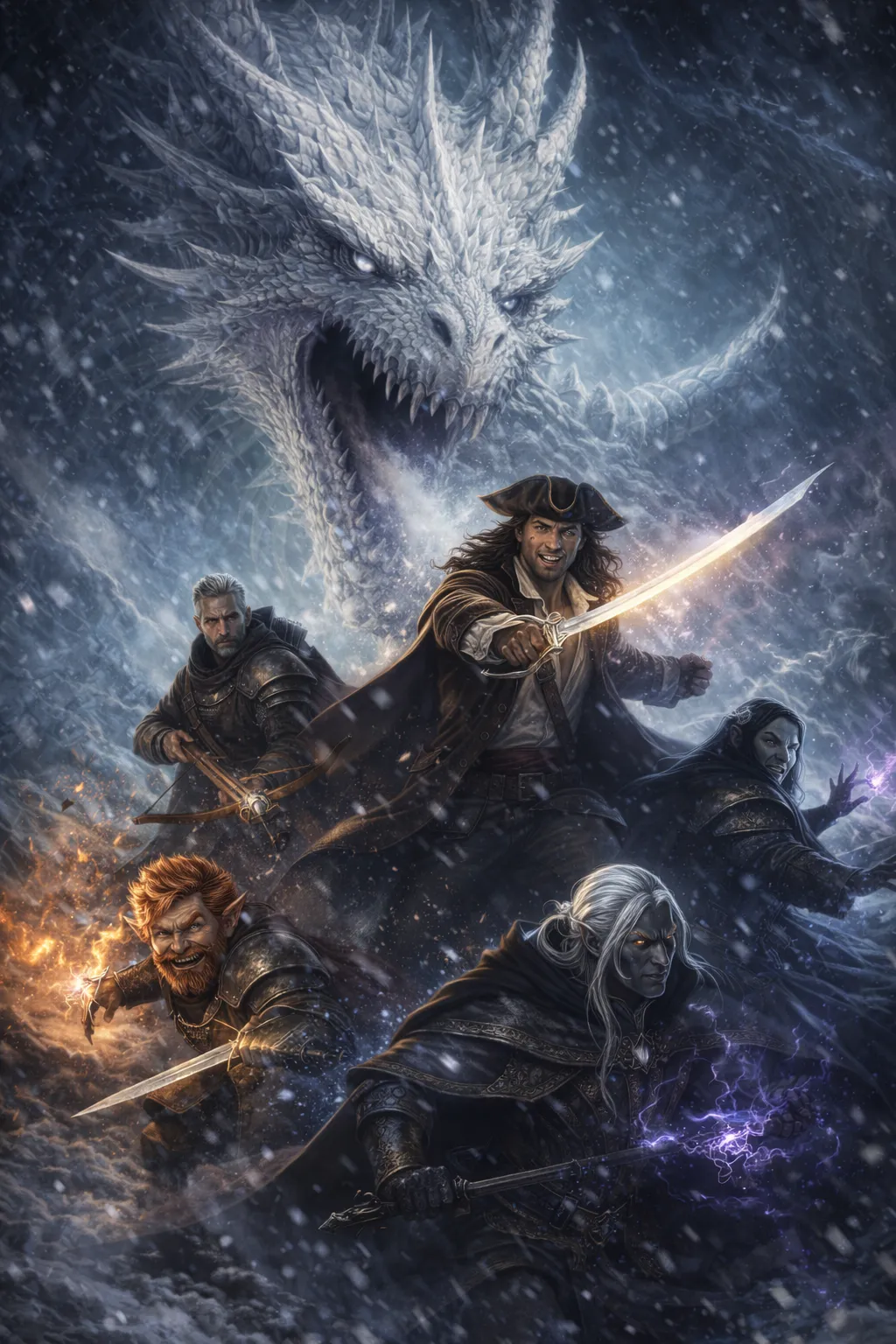
Part I: The Sky That Burned a Name
The village of Greyhook sat like a nail in the side of the world, hammered into a ledge just below the Cryreach Pinnacles. The peaks above scraped the clouds; the wind below scraped bone. No one came here by accident we.
Which suited Kerzog just fine.
He looked human today. Copper-skinned, lean, with wind-tossed black hair and a half-smile that meant trouble if you knew what to look for. His coat was old dragonhide, cracked and faded, and his boots were worn smooth from passes that no longer had names.
He sat alone in the corner of the tavern, drink untouched, eyes half-lidded, listening to the fire and the mountain and the quiet inside his own chest.
He didn’t come to Greyhook for peace. But he found it anyway. For a while.
Then the sky caught fire.
It began with a sound—crack—sharp enough to split the silence and a window along with it. The wind changed. Glass rattled in every wall. Someone dropped a tray. Someone else dropped their drink. The innkeeper swore and crossed herself.
Kerzog just stood.
He stepped out into the chill without a word, coat trailing behind him like a shadow that knew better than to ask questions.
Above the peaks, far beyond even the reach of eagles, something glowed in the aurora’s light.
A rune. No—more than that. A name. His name. Etched in molten crimson across the clouds.
The shape of it curled with ancient breath, the kind of magic that knew how to bind dragons, and the kind of oaths that could outlast kingdoms.
Kerzog stared up at it, the wind clawing his coat open.
“So,” he murmured. “She’s calling it due.”
“I knew you’d say that.”
Kerzog didn’t flinch. Didn’t look back.
A crunch of heavy boots behind him. A figure emerging from the dark—broad-shouldered, stone-skinned, wrapped in furs that had seen more blizzards than most villages.
Kragorn.
Goliath. Warrior. Wall of sarcasm and bruiser logic. And—for better or worse—Kerzog’s oldest surviving ally.
“You followed me,” Kerzog said dryly.
“I followed the wind. You just happen to sulk wherever it howls.”
“I don’t sulk.”
“Fine. Brood, then.” Kragorn stepped up beside him, arms crossed, hammer slung across his back like a threat waiting for context. “So. Skywriting. That’s new.”
Kerzog didn’t answer right away. His gaze stayed fixed on the rune. The way it shimmered. The way it lingered.
“It’s an oathmark,” he said finally. “A dragon’s call. Older than most things that breathe. I made a promise a long time ago. Looks like the world just remembered it.”
“Am I going to need my hammer?”
Kerzog’s smile was thin, tired, and something far too old to belong on a man’s face. “Eventually. But not for the reasons you think.”
That night, the two of them sat near the edge of Greyhook, fire crackling low between stacked stones. Kerzog unrolled an old, weather-beaten map, tracing the jagged lines of the Cryreach Pinnacles like they were scars.
Beyond them—further than most dared climb—was a symbol inked in silver-glass.
A dragon’s eye. Split in two.
“She ruled the skies here,” Kerzog said, voice low. “Before mortals climbed this high. Before maps dared name the peaks. I knew her. Fought beside her. Lost her.”
He tapped the map.
“I promised I would guard what she sealed away. I failed.”
Kragorn glanced toward the mountains, where the wind screamed like something hungry. Then he stood, adjusted his cloak, and hoisted his warhammer.
“Well then,” he said. “Let’s go fix it.”
The Dragon’s Debt Part II: Wind Beyond Breath (Rewritten with flight limitation explained)
They should’ve flown.
Kerzog knew it. So did Kragorn. Every muscle in their mortal shells itched with the memory of wings. The Cryreach Pinnacles stretched above them like jagged claws, practically inviting the glide of ancient scale and fire.
But the sky wouldn’t let them.
They’d tried, the night before.
Kerzog had stood on the edge of Greyhook’s cliff, eyes closed, breath deepening, calling the shape that was truly his. The dragon within. Wings had unfurled in his mind. The air had begun to burn.
And then—
Nothing.
The shift collapsed in on itself, like a door slammed in his face.
Not rejection.
Interference.
Something above the Cryreach was muting them. Not blocking their power—no, that still crackled under their skin like caged lightning—but suppressing their shape. Coiling it inward. Twisting the transformation until it turned cold and wrong.
It wasn’t a ban. It was a warning.
They would not take dragon form here. Not without cost.
So they climbed.
Kragorn led the way, silent as ever in the face of mountains. His boots punched deep tracks through snow that had never known names. He didn’t complain. He just muttered occasionally to his hammer like it owed him an explanation.
Kerzog followed close, wrapped in a cloak that steamed faintly as it shed the cold. His eyes never stopped scanning the horizon. Not for danger—but for lies. The mountain felt like a liar.
The Cryreach Pinnacles weren’t just peaks. They were wards. A cage disguised as a climb.
They crested the first ridge just before dawn.
Above them: a cliff face, impossibly sheer, carved with runes older than song. Not etched by mortal hands—but breathed into stone by dragons long gone.
One symbol pulsed faintly.
Kerzog stared up at it. “She sealed it well.”
“She?” Kragorn asked.
Kerzog didn’t respond.
Instead, he stepped forward, placed his palm against the rune—and the stone hissed beneath his touch. The air shifted. The cliff trembled.
Then it opened.
Not with thunder. Not with violence. But with silence—like something exhaling for the first time in a thousand years.
Behind it: a tunnel spiraled downward, walls shimmering with heatless light. It wasn’t just carved—it was grown, as if the mountain had been told to make space and obeyed.
Kragorn frowned. “We sure about this?”
“No,” Kerzog said. “But we’re already inside.”
The descent was slow. The deeper they went, the thicker the air became—not with dust or damp, but with intention. The walls pulsed faintly with recognition. Like they knew who walked them now.
The magic here wasn’t inert.
It was listening.
Then the scent hit them.
Not rot. Not blood. Memory. Sharp and sour and clinging.
Kragorn’s breath hitched. Kerzog grimaced.
“I know this smell,” Kragorn muttered. “This is what it felt like in Silnorith. When we were too late.”
Kerzog didn’t reply. Just nodded, once. And kept walking.
The path ended in a chamber.
Circular. Vaulted. Rimmed with ancient dragon-bone and obsidian altars shaped like wings.
And at its center, wreathed in frost and stillness, stood a single figure.
Armored in black. Face hidden beneath a helm carved like a dragon’s skull. Tall. Motionless. Silent.
Until Kerzog stepped closer.
Then it moved.
And spoke in a voice that cracked the ice in the seams of the room:
“You come in skin not your own. You come without wings. You come… in failure.”
Kerzog didn’t flinch. “I come to fix what broke.”
The guardian tilted its head. “You broke it.”
And then the runes ignited.
The Dragon’s Debt Part III: The Guardian That Remembers
The runes around the chamber flared to life.
Not just glowing—burning—etched fire racing across dragonbone and obsidian like veins filled with light. The frost hissed. The air thickened. The silence cracked.
The guardian stepped down from the dais, heavy boots thudding on the stone. Not fast. Not aggressive.
Deliberate.
Kragorn tightened his grip on his hammer.
Kerzog didn’t move.
The figure's helm stared at them, the carved dragon skull gleaming with reflected flame. Its voice—when it came again—was steadier. Colder.
“You wear false skin. You hide from what you are. Why?”
Kerzog’s voice was calm. “Because the mountain won’t let us be otherwise.”
“Good,” the guardian said. “You are not worthy.”
Kragorn snorted. “Friendly.”
The helm turned toward him. “You were not named.”
“I usually don't wait to be.”
With a roar of stone and spell, the guardian surged forward.
The first clash shook the room.
Kragorn met the blow head-on, hammer to blade, sparks cascading across the frost-slick floor. The impact knocked him back a step, but he planted firm—feet braced, stance like a fortress.
Kerzog moved differently—circling, eyes locked on the runes. Reading them. Remembering.
“They’re test runes,” he murmured. “Challenge scripts. Bound by oathstone.”
Kragorn grunted. “Translation?”
“It doesn’t want to kill us.”
“Feels like it’s trying.”
“Then we fail the test.”
The guardian was fast.
Too fast for something that heavy.
It spun, blade carving through the air like it had a will of its own, chaining strikes that forced Kragorn to give ground. But he didn’t falter. He redirected, absorbed, twisted. He endured.
That was his gift. And his curse.
Kerzog stepped in, cloak flicking aside, hands raised—not to strike, but to draw.
Glyphs. In the air. One by one. Glowing copper, like molten memory.
The guardian paused mid-swing.
“You remember the shapes,” it said.
“I helped write them,” Kerzog replied. “Before the pact fractured.”
The fire in the runes around the chamber dimmed.
The guardian lowered its blade—only slightly.
“Then prove it.”
The second test wasn’t a battle.
It was a word.
Spoken in Old Draconic. Sharp and hard and impossible to fake.
Kerzog said it without hesitation.
The room responded—stone shifting, light trembling. One of the altars cracked open, revealing a narrow stair descending deeper.
The guardian stepped aside.
“You may pass.”
Kragorn raised a brow. “That’s it?”
“No,” the guardian said. “You’ve passed the gate. Not the cost.”
Kerzog hesitated. “What cost?”
The guardian looked at him—really looked, as if trying to see past the skin, past the bones, to what he used to be.
“When you sealed it last,” it said, “you left part of yourself behind.”
Kerzog felt it then.
Something under the mountain stirring. Not malicious. Not angry.
Just… forgotten.
And waking.
The Dragon’s Debt – Part IV: What the Mountain Forgot
The stairs spiraled downward into breathless dark.
Not a natural dark—not the absence of light, but the presence of something else. The kind of dark that bent echoes and soaked heat. Kragorn’s hand grazed the wall. It pulsed faintly, like a heartbeat slowed to stone.
Kerzog walked ahead without torch or hesitation.
“Do you feel that?” Kragorn muttered.
Kerzog nodded. “It remembers us.”
The air grew warmer. Not fire-warm, but womb-warm—heavy with potential and memory. The stair ended in a narrow throat of obsidian that opened into a vast chamber… and in its center, coiled in strands of silver and ash, was a shape.
It wasn’t alive.
And it wasn’t dead.
A mirror of Kerzog, carved in perfect stillness. Wound in dragonbone. Suspended in runes that didn’t glow—they waited.
Kragorn stopped short. “That’s you.”
Kerzog didn’t answer. He stepped forward, and the runes around the suspended figure reacted—slowly spinning, aligning, like a lock being tested.
“What is this?” Kragorn asked.
Kerzog looked up at the echo of himself, eyes suddenly heavier than time.
“It’s what I gave up to seal the oath,” he said. “My name. My flame. The piece of me that knew why it mattered.”
Kragorn’s brow furrowed. “So we’re here to… take it back?”
“No,” said a voice behind them.
The guardian.
But not armored now.
It had followed them—or maybe it had always been here—but now it stood unmasked. Not a figure of threat, but of sorrow. Its eyes glowed not with power, but recognition.
“You are here to remember.”
The air in the chamber thickened, not with heat or smoke, but memory. Kragorn tasted it on his tongue—like old fire, like lost songs.
The guardian stepped forward, unmasked and bare. Not a man. Not a dragon. Something between.
Kerzog turned, voice quiet. “You remember me.”
The guardian nodded. “I was your echo, once. A shadow cast from the part you left behind. Bound to protect what you abandoned, until you returned… or the mountain died.”
“I never meant to forget,” Kerzog said.
“No one ever does,” the guardian replied. “But forgetting is part of sealing. Part of surviving.”
Kragorn stepped between them, wary. “So what now? You want to give it back?”
The guardian looked at Kerzog.
“I can’t give it. You must choose to take it. And if you do—what you were will burn its way through what you’ve become. You may not survive the merging. And if you fail…”
He gestured to the figure in the runes. “You won’t be the only one who dies.”
Kerzog approached the suspended image of himself.
It pulsed now. Reacting to his closeness. The runes sparked—one by one—old truths lighting up like stars in a night he thought he’d forgotten.
“I remember her name,” he whispered. “The one who sealed it with me.”
The chamber trembled slightly.
Kragorn flinched. “That a good thing?”
“She was the first dragon to choose mortality,” Kerzog said, voice distant. “To bind herself to time so her oath would outlast the war. I loved her for that.”
The guardian nodded. “And you helped her bury it. This piece of you. To keep it safe. To keep it out of her enemy’s grasp.”
“Whose enemy?” Kragorn asked.
The guardian turned. “Yours, now.”
The tremor became a quake.
Dust fell from the vaulted ceiling. The runes flared in sudden alarm.
Something outside the chamber had awakened.
Something else had been listening.
Kerzog turned, face hardening. “Too late for slow choices.”
He placed his palm against the mirrored version of himself.
The runes screamed.
And the mountain answered.
Kerzog’s hand met the mirrored form and the chamber convulsed.
Light—no, truth—poured outward from the suspended self, the runes no longer spinning but collapsing inward, folding space and memory like paper around a fire.
Kragorn stumbled back as the heat hit—an ancient heat, the kind that remembered the first sun, the kind that could melt gods and forge dragons. The figure in the center cracked like glass.
Kerzog gritted his teeth. His hand didn’t waver.
The guardian stepped forward, shielding Kragorn with a sweep of one wing—not real, not flesh, but memory-given-shape.
“This is it,” the guardian said. “If he lets go now, he survives. But loses the truth again.”
“I don’t think he’s the letting-go type,” Kragorn muttered.
Kerzog screamed.
Not in pain—but in recognition.
The mirrored form shattered. The runes exploded outward in a ripple of burning glyphs. The blast knocked them all to the ground—except Kerzog, who hung there, suspended midair, skin flickering between mortal and draconic, veins lit with flame, eyes full of names no one else had earned the right to speak.
Then came the second sound.
Claws on stone.
From the tunnel above.
Kragorn snapped to his feet. “We’ve got company.”
The guardian turned sharply. “It followed the memory. It shouldn’t have been able to.”
Kerzog dropped to one knee, breath ragged, smoke coiling from his skin.
“What is it?” he asked.
The guardian’s face darkened. “The one who broke her. Who hunted the oathbearers. The storm-forged shadow. The one you called Malthis the Mourner.”
Kragorn raised his hammer. “That thing’s still alive?”
“Alive is not the word,” the guardian growled. “He remembers himself too well.”
From the tunnel mouth, the stone bent outward—ripped apart by force and will.
And there he stood.
Malthis.
Armor of fused obsidian and bone. A sword made from a dragon’s rib. A crown of shattered promises bound in black iron.
His voice echoed like a dirge.
“I see you’ve found your heart again, Kerzog.”
He smiled.
“Let’s see if you’ve remembered how to die.”
Kerzog stood slowly, steam rising from his shoulders, his hand no longer trembling.
“Malthis,” he said, voice like gravel and storm.
The name was heavier now. Not just a title. A wound reopened.
Malthis stepped into the chamber, his presence drawing the heat from the walls. The guardian’s light dimmed in response, the runes flickering like dying stars.
“You should’ve stayed sealed,” Malthis said, dragging the rib-sword behind him. “I liked you better when you were incomplete.”
Kragorn snorted. “And I liked my breakfast before your face ruined the room.”
Malthis didn’t flinch. “You brought your boulder again. Good. I’ve missed the sound of your bones breaking.”
“Try me,” Kragorn growled, hammer swinging into his grip.
Kerzog raised a hand.
“No.”
Kragorn blinked. “No?”
“Not yet.”
He stepped forward, flames curling from his heels, eyes glowing with a light that didn’t flicker—it commanded.
Malthis tilted his head. “You’re whole, then. Let’s see what that’s worth.”
He moved like a fracture—impossible angles, sudden and wrong. His blade sang through the air, cutting a line of shadow that hissed against stone.
Kerzog met him mid-strike.
No weapon. Just hands. Just fire.
When they collided, the mountain screamed.
The chamber cracked along its veins. Runes shattered and reformed in the same breath. Malthis’s blade met Kerzog’s bare palm—and halted.
Only halted.
And then began to melt.
Malthis snarled. “What did you do?”
Kerzog leaned in, voice low, steady.
“I stopped forgetting.”
With a blast of heat that turned obsidian to magma, Kerzog surged forward—no longer man, not yet dragon, something in between. The fire wasn’t around him. It was him.
Malthis reeled back, cloak smoking, armor cracked.
And Kragorn charged in from the side, hammer roaring like thunder.
The battle turned chaos. Runes exploded. The guardian threw up wards to protect what remained of the chamber. Kragorn’s hammer found ribs. Malthis’s blade found blood. Kerzog’s fire found everything.
And at the heart of it all, past the violence, past the spellwork, past the pain—
A voice whispered from the flame:
“You are not alone.”
Kerzog turned his head sharply.
Not Kragorn.
Not the guardian.
A third voice.
Familiar.
And impossible.
She was waking.
The battle surged around them like a storm with no sky. Fire collided with shadow, steel clashed against spell, and the mountain trembled beneath ancient weight.
And then— She breathed.
Not a gasp. Not a whisper.
A breath that rolled through the stone, slow and deep and older than language. Every rune in the chamber flickered in response. Even Malthis froze, mid-swing, eyes narrowing.
“No,” he hissed. “Not her. Not again.”
From beneath the floor, light spilled upward—soft at first, like sunrise through mist. The runes re-formed into a spiral, and at its center, a figure began to rise.
She wasn’t fire. She wasn’t flesh. She was will.
A woman-shaped echo of a dragon’s heart. Scales that shimmered like moonlit quartz. Eyes like starfall. Wreathed in the remnants of a mortal form bound by promise, not death.
Kerzog stumbled a step, not from pain—but from memory.
“Seralyth…”
The name landed like thunder in the chamber. Even the guardian bowed its head.
Malthis bared his teeth. “You gave her to the mountain. You buried her.”
“She chose it,” Seralyth said, voice layered with echoes of herself, and others, and more. “I chose me. And now I choose again.”
She turned to Kerzog. Her gaze didn’t blame.
It burned.
“You came back late.”
“I never stopped coming,” Kerzog said. “Just forgot how.”
“Then remember this—”
She reached toward him, and their hands touched.
A pulse rippled outward.
Kerzog’s form shifted—just for an instant. Wings of fire. Scales beneath skin. A shape larger than space.
Not a full dragon.
But a truth becoming real.
Seralyth turned to Malthis.
“You wanted a war without oaths. A world where nothing is promised, nothing is sacred.”
Malthis raised his blade again, though now his hands trembled.
“And I will finish what you sealed to stall.”
Seralyth’s smile was sharp and sorrowful.
“You won’t finish anything.”
She raised her hand.
And the pact ignited.
Behind her, ghost-forms appeared—not undead, but remembered. Echoes of those who had once sworn the flamebound promise. Their shapes weren’t fully there—but their eyes were.
Watching.
Judging.
Waiting.
Malthis hesitated.
Too late.
Kerzog moved.
Not fast.
Not strong.
Just right.
His palm touched Malthis’s chest.
The fire that erupted wasn’t heat—it was memory, reclaiming what had been stolen, unraveling a thousand years of twisted intention.
Malthis screamed as his form buckled, split, and collapsed—not into ash—
But into silence.
Not gone.
Just…
Unremembered.
The Dragon’s Debt – Part VII: Embers of a Name
The chamber was still.
No more runes flared. No more fire danced. No more echoes screamed.
Just a glow—soft, warm, old as breath—flickering around the three who remained.
Kragorn leaned against his hammer, watching the space where Malthis had stood. “He’s really gone?”
Kerzog didn’t answer right away. He stood quietly, eyes closed, letting the silence settle.
“He’s not remembered,” Seralyth said. “And in this place, that’s deeper than death.”
Kragorn nodded slowly. “Good. He deserved to be forgotten.”
Seralyth turned toward Kerzog, expression gentled. “You’ve changed.”
“So have you.”
They stood in it a while—the ache of a vow kept too late, but still kept.
“I don’t belong in this world anymore,” she said, her voice not sad—just true.
Kerzog stepped closer. “Then I’ll walk you to its edge.”
She smiled at that. “Still poetic. Still stubborn.”
He reached out, brushed a strand of light from her face.
And then she stepped back—into the spiral of runes that had once sealed her fate. Her form grew fainter with each breath.
One last glance at him.
“Remember the promise, dragon.”
“I will.”
The light faded. The runes dimmed. The chamber fell into shadow again—this time, gentle.
Kragorn exhaled. “Well. That was… a lot.”
Kerzog gave a thin smile. “She always had a flair for goodbyes.”
They began the climb back up, side by side. The mountain no longer fought them. No wards, no echoes. Just stone. And sky. And the wind through a name no longer cursed.
At the ridge above Greyhook, the stars had shifted. The sky was no longer writing names in fire.
It didn’t need to.
Kerzog sat at the edge.
Kragorn beside him.
They didn’t speak much.
Didn’t need to.
But just before the dawn broke, Kerzog said, “We should check on the others.”
“The Hand?” Kragorn asked.
Kerzog nodded. “It’s time they knew what was under the mountain.”
Kragorn stretched. “They’re not going to like that.”
“No,” Kerzog said. “But they’ll understand.”
And then—
The wind shifted.
Soft.
Like wings.
END.
Epilogue – The Welcoming Hand
The tavern was warm, loud, and entirely unaware that the mountain had nearly remembered itself into destruction.
Talia Vey sipped her wine like it had wronged her. Zook was under the main table again, tinkering with something that had already exploded once. Deacon Bruce sat at the far end, polishing one of his crossbows with the grim concentration of a man who expected to use it shortly.
“So you’re telling me,” Talia said, slow and skeptical, “that the sky literally caught fire?”
Kerzog, seated near the hearth, nodded once.
“And screamed our names,” Kragorn added.
Zook popped up holding a copper gear fused to a bone fragment. “Was it a good scream or, like, a bad omen scream?”
Before Kerzog could answer, the door blew open.
Snow whirled in. So did Jandar.
Grinning. Smug. Hat flawless.
And dragging behind him a wagon wheel-sized rune disk made of molten obsidian and faintly humming silver.
“Guess what I found tumbling down the mountain path,” he said cheerfully.
Everyone stared.
Deacon didn’t look up. “That’s cursed.”
“Probably,” Jandar said. “But also? It makes a great cheese board.”
Kerzog blinked. “That was embedded in the pact chamber.”
“Ohhh,” Jandar said, swinging it onto the table with a thud that cracked a few mugs. “So that’s why it whispered when I touched it.”
Talia rubbed her temples. “What did it whisper?”
Jandar grinned. “Something about eternal binding flame and a name unforgotten. You know. Sexy mountain stuff.”
Kragorn sighed. “How are you alive?”
“Who says I am?” Jandar winked. “Or maybe this is just a very attractive ghost.”
The fire cracked.
The cheese arrived.
And, as usual, no one questioned it too hard.