WRITTEN RECAP
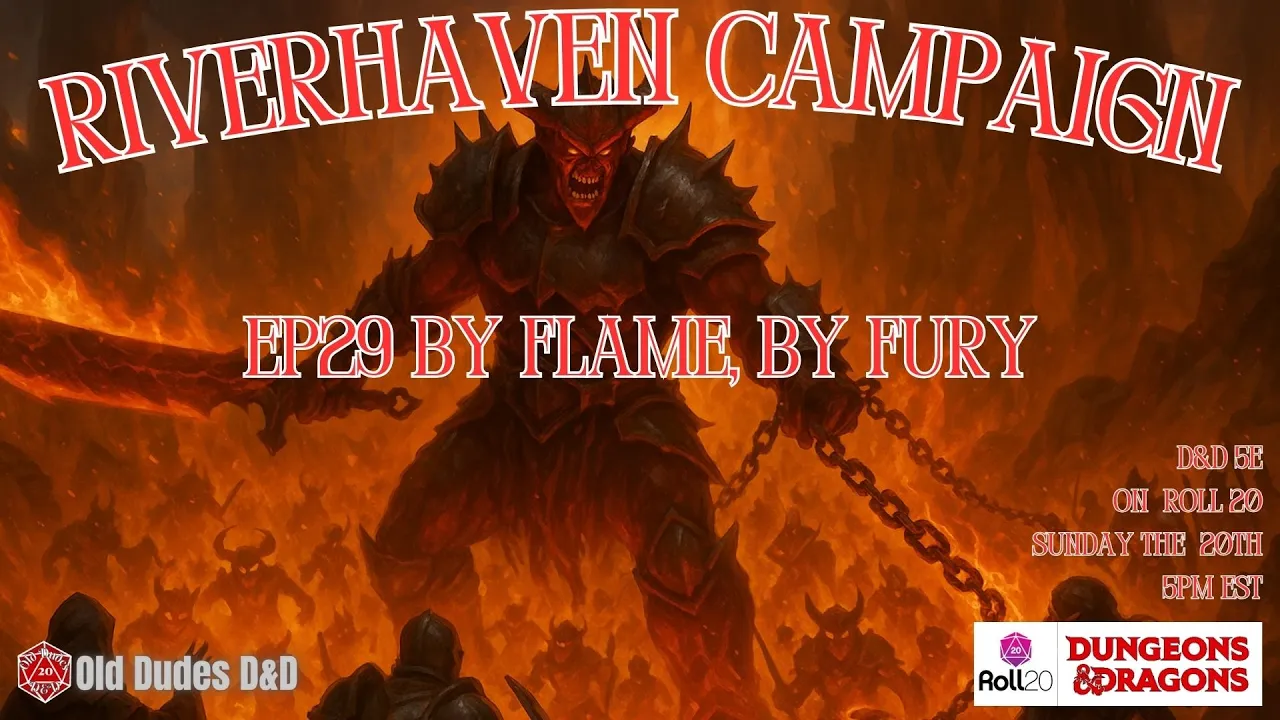
The infernal prison continues to come apart around the party.
Every chamber they clear reveals another piece of a system built to hold Taros in place: chains, wardens, rift anchors and sealed passages that connect the world beneath Riverhaven to a hostile infernal space beyond it.
The party's problem is no longer finding the prison.
It is surviving the process of moving through it without becoming the people who accidentally finish breaking it.
The session opens with the group deep in the ward network, recovering from the previous chain battles and trying to determine which direction actually leads toward the inner rift. The heroes have begun recognizing the visual language of the prison. Chains mean control. Cores mean access. Fire means almost everything is about to become unpleasant.
As they move, the complex introduces new defenders and new variations on the same theme. Fiends attack from positions protected by lava and magical barriers. Infernal weapons animate. Passageways force the party to cross exposed ground while enemies use reach and restraints to control the battlefield.
The Old Dudes respond with increasingly aggressive tactics.
Subtlety had a good run.
Hayben drives forward with the confidence of someone carrying weapons powerful enough to have their own names. Sspaa looks for angles where arrows can reach enemies that think chains make them safe. Eth's Blade of Eternal Hunger continues to demand dominance and violence, creating a second threat inside the party even while devils attack from outside. Drachen's mix of magic and martial defense proves useful against enemies designed to punish anyone who relies on only one kind of protection.
Several rooms also reveal more Aegis involvement.
The ancient shield-wizards did not operate separately from Riverhaven's infernal defenses. Their vault network and magical traditions appear connected to the systems that were supposed to keep powers like Taros and Umbraxion contained.
That realization broadens the campaign again.
Drachen's personal Aegis investigation, Umeren's shadow artifacts, Hayben's Steelwind history and the infernal crisis are not four unrelated character stories.
They are pieces of Riverhaven's old defense network failing at the same time.
The party eventually emerges from another vault section carrying more pieces of the answer. The inner seals are damaged, and the group is warned that containing Taros permanently may require restoring more than the infernal chains. The Aegis Arcanum had its own method for locking dangerous vaults and prisons.
There is a crown involved.
That clue is not yet fully explained, but it gives the party a second objective beyond simply killing Taros: locate the Aegis relics capable of restoring the larger ward network.
The episode spends much of its time in combat, but the cumulative effect is important. The heroes are no longer reacting to isolated disasters. They are standing in the machinery behind those disasters and seeing how the pieces connect.
The festival sabotage weakened an infernal seal.
Zarven's network exploited old tunnels.
The chain wardens protected access to Taros.
The Aegis vaults contain tools designed to seal threats like this.
And somebody has been attacking all of those systems from multiple directions.
The action has another layer as well. The heroes fight through fiery vault passages and more infernal defenders while learning that the Taros crisis is linked to the wider Aegis network. The group has to learn the place while moving through it, and that makes every new clue immediately practical. A symbol can become a key. A prisoner can become a witness. A strange relic can be the reason the next door opens—or the reason everybody suddenly needs a saving throw. Riverhaven has trained the party to treat exploration as part of the danger instead of the quiet time between fights.
When the fighting starts, lava, barriers and restraints make positioning unusually important, and ranged attackers have to reach targets the front line cannot safely stand beside. The heroes increasingly work as a real unit rather than five or six separate character sheets. The front line buys room for archers and spellcasters, the scouts try to keep the group from walking blind into the next threat, and healing is saved for the moments when somebody is one bad hit from disappearing. The exact plan changes from room to room, but the basic trust underneath it is becoming one of the party's strongest advantages.
Naturally, none of that prevents the table from wandering into its own kind of trouble. The group spends as much effort deciding which mechanism should remain intact as it does deciding which monster should die first. That is the Old Dudes rhythm by now: somebody makes the sensible observation, somebody else makes the joke, and a third person pushes the button while the discussion is still happening. The humor never really stops the adventure. Most of the time it is happening at exactly the same moment the characters are making decisions that could get them killed.
Underneath the jokes, the character stakes keep moving. Drachen’s Aegis thread and Umeren’s Umbraxion knowledge begin intersecting directly with Hayben’s and Eth’s infernal weapons. Riverhaven has become very good at bringing old choices back around. A weapon found months earlier can suddenly matter to a new enemy. An NPC rescued in one arc can become the person who explains the next. A disgrace, curse, vision or bloodline that began as backstory can eventually become the reason the whole party is standing in a particular room.
The larger pattern also gets harder to ignore. The first information about the Crown of the Aegis Arcanum suggests that restoring Riverhaven permanently will require more than winning the Taros fight. At first the heroes could treat the Gloomstalkers, the Steelwind Dragoons, the Aegis Arcanum, Umbraxion, the infernal prisons and the planar breaches as separate mysteries. With every new site, that becomes less believable. Riverhaven was protected by overlapping systems and orders, and somebody—or several somebodies—has been finding the weak points in all of them.
By this stage of the campaign, the heroes have enough history that resource choices carry consequences. A spell slot used on the first guardian may not be there for the boss. A potion forgotten in a backpack can suddenly matter. A cursed weapon may solve today's fight while creating next week's problem. The players spend plenty of time checking ranges, conditions, concentration and inventory, but those rule questions are attached to real stakes now because the group has people, places and unfinished promises it is trying to get back to alive.
By the time the immediate danger settles, the episode leaves the party close to the central confrontation but already aware that the larger vault problem will remain afterward. The party rarely gets a clean reset after a victory. One answer exposes another door, and one rescued person usually knows the name of the next place nobody wants to visit. That momentum is what carries Riverhaven forward: the heroes keep solving the problem in front of them only to discover that it was connected to something older, larger and usually much less willing to stay buried.
That combination puts a different kind of pressure on the group. Drachen’s Aegis thread and Umeren’s Umbraxion knowledge begin intersecting directly with Hayben’s and Eth’s infernal weapons. The heroes cannot treat the episode as an isolated job because the people and relics involved already have history with them. What would once have been a simple decision about whether to press forward now carries obligations: promises made to Riverhaven, old orders that need restoring, curses that have to be controlled, or ancient defenses that may fail if the wrong piece is disturbed.
Even the quieter stretches remain tense because the first information about the Crown of the Aegis Arcanum suggests that restoring Riverhaven permanently will require more than winning the Taros fight. The party spends those moments checking what it has learned against what it has already seen, trying to decide whether a familiar symbol means safety or simply a familiar kind of danger. Then the episode leaves the party close to the central confrontation but already aware that the larger vault problem will remain afterward. The result is another Riverhaven transition where the solution to one scene becomes the map to the next problem before anyone has time to decide they are finished for the day.
By the end of Episode Twenty-Nine, the party has fought through another punishing section of the prison and moved closer to the central confrontation.
Fire is everywhere.
The chains are failing.
And the heroes now know that even if they defeat Taros, Riverhaven will remain vulnerable until the ancient seals themselves are restored.