WRITTEN RECAP
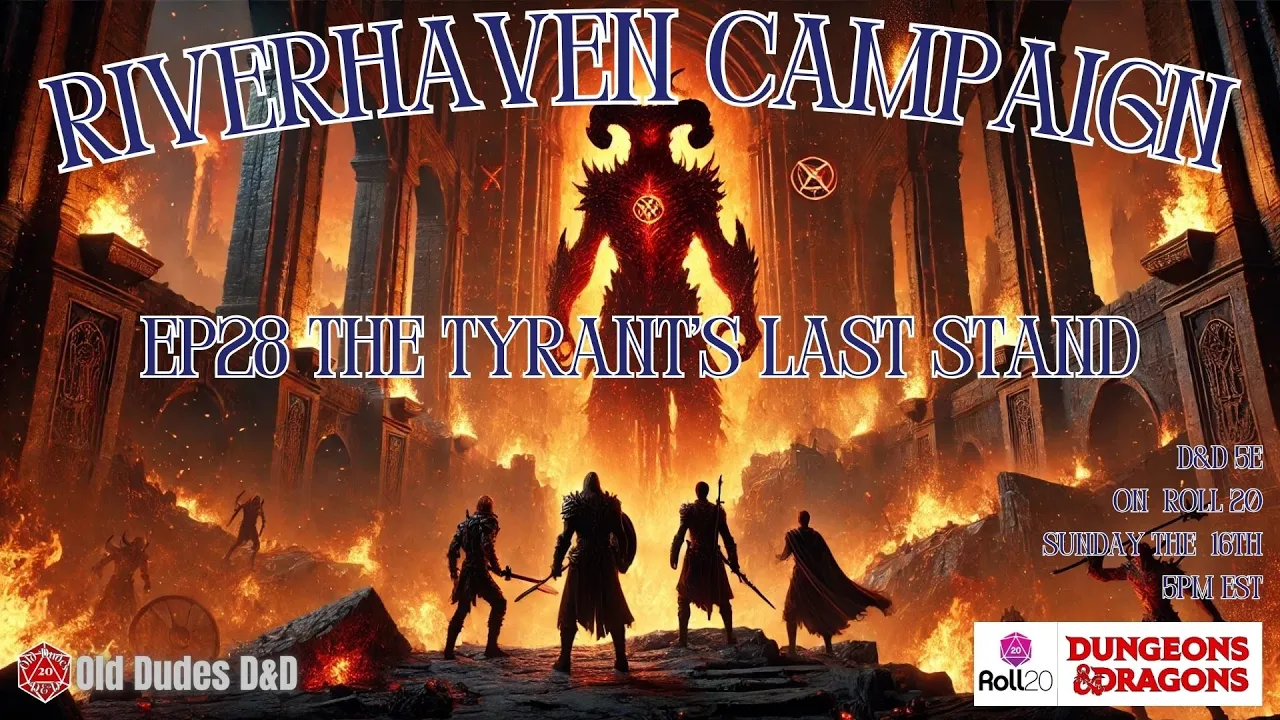
Riverhaven — Episode 28: The Tyrant'S Last Stand
With one binding core recovered, the party finally has enough information to understand the shape of the infernal problem.
Taros is imprisoned beyond a rift. The prison is maintained through a network of chains, anchors and warding cores. Those systems are failing—or being deliberately broken—and the heroes need enough control over the remaining mechanisms to reach the threat before it reaches Riverhaven.
The group briefly returns to the Silverfish Inn and the city to recover, buy supplies and perform the traditional pre-apocalypse shopping trip. Potions become especially important because the recent fights have made one thing clear: the enemies below Riverhaven hit much harder than cultists in cloaks.
Then the party goes back down.
The next section of the infernal prison is built around the idea of restraint. Chains hang through chambers, cross open spaces and animate when intruders approach. Wardens are connected to the structure itself, using lashes and binding effects to drag targets out of position.
The party has to learn the prison's logic while fighting inside it.
Destroy every chain and they may free exactly the thing they came to stop.
Leave every chain intact and they may never reach the inner prison.
That balance makes each encounter more complicated than simply killing the biggest creature in the room.
The recovered metal shard provides clues. It is part of the rift and Taros's binding, proof that the wardens are carrying or protecting components needed to pass between sealed sections. The party begins treating each major guardian as both an enemy and a possible key.
One combat in particular becomes a mess of chain lashes, restraints and attempts to keep front-line characters from being isolated. Hayben and the others absorb punishment while the ranged characters pick apart targets from safer positions. Umeren keeps people alive. Drachen uses magic where armor alone is not enough. Eth's cursed blade continues encouraging violence with the enthusiasm of a weapon that has never had to make a death save.
The party wins, but the victory does not feel clean.
Every broken binding makes the environment more unstable. Heat increases. Infernal energy leaks through the wards. The architecture itself seems to react to the weakening prison.
The heroes eventually reach another transition point and realize they can now move closer to Taros.
That is technically progress.
It is also exactly what Taros's servants want.
The session title promises a tyrant's last stand, but the deeper truth is that the heroes are still fighting the tyrant's jailers and corrupted guardians rather than Taros himself. The "last stand" is the prison's defensive structure trying to function while multiple factions pull it apart.
The Old Dudes repeatedly have to decide whether the creature in front of them is keeping Taros contained, trying to release him or simply trying to kill them because they are there.
This is not the sort of dungeon where alignment can be determined by which side of the door someone stands on.
The action has another layer as well. The party briefly returns to Riverhaven for supplies before reentering the chain prison and moving through another series of warded infernal chambers. The group has to learn the place while moving through it, and that makes every new clue immediately practical. A symbol can become a key. A prisoner can become a witness. A strange relic can be the reason the next door opens—or the reason everybody suddenly needs a saving throw. Riverhaven has trained the party to treat exploration as part of the danger instead of the quiet time between fights.
When the fighting starts, each major defender is both an enemy and part of the lock, so destroying the wrong connection too early can make the environment more unstable. The heroes increasingly work as a real unit rather than five or six separate character sheets. The front line buys room for archers and spellcasters, the scouts try to keep the group from walking blind into the next threat, and healing is saved for the moments when somebody is one bad hit from disappearing. The exact plan changes from room to room, but the basic trust underneath it is becoming one of the party's strongest advantages.
Naturally, none of that prevents the table from wandering into its own kind of trouble. Potion shopping and inventory management become the calm before another stretch where characters are repeatedly wrapped, dragged and battered by chains. That is the Old Dudes rhythm by now: somebody makes the sensible observation, somebody else makes the joke, and a third person pushes the button while the discussion is still happening. The humor never really stops the adventure. Most of the time it is happening at exactly the same moment the characters are making decisions that could get them killed.
Underneath the jokes, the character stakes keep moving. The cursed swords continue pressing their owners while the party’s front line increasingly has to protect companions who are immobilized rather than simply wounded. Riverhaven has become very good at bringing old choices back around. A weapon found months earlier can suddenly matter to a new enemy. An NPC rescued in one arc can become the person who explains the next. A disgrace, curse, vision or bloodline that began as backstory can eventually become the reason the whole party is standing in a particular room.
The larger pattern also gets harder to ignore. The binding cores show that earlier defenders built Taros’s prison as a layered system rather than one seal, explaining why the current sabotage can fail in stages. At first the heroes could treat the Gloomstalkers, the Steelwind Dragoons, the Aegis Arcanum, Umbraxion, the infernal prisons and the planar breaches as separate mysteries. With every new site, that becomes less believable. Riverhaven was protected by overlapping systems and orders, and somebody—or several somebodies—has been finding the weak points in all of them.
By this stage of the campaign, the heroes have enough history that resource choices carry consequences. A spell slot used on the first guardian may not be there for the boss. A potion forgotten in a backpack can suddenly matter. A cursed weapon may solve today's fight while creating next week's problem. The players spend plenty of time checking ranges, conditions, concentration and inventory, but those rule questions are attached to real stakes now because the group has people, places and unfinished promises it is trying to get back to alive.
By the time the immediate danger settles, the party moves another layer inward and runs out of protective distance between itself and the infernal champion. The party rarely gets a clean reset after a victory. One answer exposes another door, and one rescued person usually knows the name of the next place nobody wants to visit. That momentum is what carries Riverhaven forward: the heroes keep solving the problem in front of them only to discover that it was connected to something older, larger and usually much less willing to stay buried.
That combination puts a different kind of pressure on the group. The cursed swords continue pressing their owners while the party’s front line increasingly has to protect companions who are immobilized rather than simply wounded. The heroes cannot treat the episode as an isolated job because the people and relics involved already have history with them. What would once have been a simple decision about whether to press forward now carries obligations: promises made to Riverhaven, old orders that need restoring, curses that have to be controlled, or ancient defenses that may fail if the wrong piece is disturbed.
Even the quieter stretches remain tense because the binding cores show that earlier defenders built Taros’s prison as a layered system rather than one seal, explaining why the current sabotage can fail in stages. The party spends those moments checking what it has learned against what it has already seen, trying to decide whether a familiar symbol means safety or simply a familiar kind of danger. Then the party moves another layer inward and runs out of protective distance between itself and the infernal champion. The result is another Riverhaven transition where the solution to one scene becomes the map to the next problem before anyone has time to decide they are finished for the day.
By the end of the episode, the party has pushed another layer deeper, secured additional information about the binding and survived fights designed to immobilize and isolate them. The path toward the infernal champion is opening.
So are the seals.
Riverhaven's heroes are running out of distance between themselves and Taros.
Soon, there will be no more wardens left to fight first.