WRITTEN RECAP
The party begins inside the object that fell from the sky.
The first celestial-looking guardian has already been defeated. Its death opened a stairway into a lower circular chamber where several more beings wait, chanting or speaking in a language the group does not immediately understand.
Combat resumes almost at once.
The enemies look celestial, but appearance is not enough to establish motive. Their magic and behavior suggest they are defending something inside the fallen structure, and the party has arrived without an invitation.
The fight pushes through the chamber and deeper into the object.
The heroes begin finding architecture that does not fit any simple explanation of a crashed vessel. Gates, void-like spaces, records and old-looking construction suggest that whatever fell from the sky is connected to a much older complex—or has exposed one.
That distinction matters when Drachen consults the completed Crown of the Aegis Arcanum.
The crown has records of the known vaults.
It does not recognize this place.
An observatory or hidden installation appears to exist outside the Aegis history Drachen now carries.
That means somebody built another layer of magical infrastructure around Riverhaven without the Aegis recording it—or built it before, after or deliberately apart from them.
The party continues exploring.
At one point they encounter a figure who identifies himself as Thomas Pike. The name connects strangely to family history, including references to an ancestor with the same name that nobody remembers being discussed before.
The session repeatedly circles around names, memory and things that were deliberately removed from ordinary history.
The heroes pass through more gates and chambers, some opening onto void-like spaces similar to the planar disturbances Sspaa has begun learning to sense as a Krysari.
Sspaa's new role is therefore immediately relevant. A strange threshold is no longer merely an interesting magical effect; it may be a breach between planes.
Elsewhere, murals or records appear to preserve military history connected to the Steelwind Dragoons. Captain names and old tales surface in rooms that should not have any obvious relationship to Hayben's recently reclaimed banner.
Riverhaven's character threads are converging again.
The Crown reacts to the architecture.
Sspaa can sense planar instability.
Hayben recognizes pieces of military history.
Eth, free of the Blade of Eternal Hunger, is carrying another secret connection—Esodius as a patron—that the rest of the party does not yet know about.
Eventually the heroes reach a war-room-like area and a shrine or ceremonial space behind another gate.
The crown helps reveal that an inscription here does not match the original architecture. It was added later.
The wording describes an oath to something that shall not be spoken.
A silent oath.
A name deliberately withheld.
No clean explanation follows. Whoever or whatever that oath serves remains unnamed, and the silence around it feels deliberate rather than accidental.
The room contains statues of old soldiers.
Umeren or the party's magical senses reveal that undead presences are resting within them.
With only minutes left in the session, everyone discusses whether stepping into the room is a good idea.
Someone steps into the room.
The statues turn.
Spirits begin emerging.
Eight of the figures animate while the Old Dudes immediately announce several alternative plans, including running away and going to Maine with Jay.
That is where the Riverhaven material in this archive truly ends.
The action has another layer as well. Inside the fallen structure, the party fights more celestial-looking beings, passes gates and void-like spaces and finds architecture that looks older and stranger than a simple crashed object. The group has to learn the place while moving through it, and that makes every new clue immediately practical. A symbol can become a key. A prisoner can become a witness. A strange relic can be the reason the next door opens—or the reason everybody suddenly needs a saving throw. Riverhaven has trained the party to treat exploration as part of the danger instead of the quiet time between fights.
When the fighting starts, the heroes move from open combat into exploration where gates, planar thresholds and undead presences are potentially more dangerous than obvious enemies. The heroes increasingly work as a real unit rather than five or six separate character sheets. The front line buys room for archers and spellcasters, the scouts try to keep the group from walking blind into the next threat, and healing is saved for the moments when somebody is one bad hit from disappearing. The exact plan changes from room to room, but the basic trust underneath it is becoming one of the party's strongest advantages.
Naturally, none of that prevents the table from wandering into its own kind of trouble. After hours of strange lore, the final decision is beautifully simple: somebody steps into the statue room, the spirits animate and several players announce they would rather go to Maine. That is the Old Dudes rhythm by now: somebody makes the sensible observation, somebody else makes the joke, and a third person pushes the button while the discussion is still happening. The humor never really stops the adventure. Most of the time it is happening at exactly the same moment the characters are making decisions that could get them killed.
Underneath the jokes, the character stakes keep moving. Drachen’s completed Crown cannot fully identify the site, Sspaa’s Krysari senses are relevant to the voids, Hayben sees Steelwind history, and Eth secretly carries an Esodius patron connection the party does not know. Riverhaven has become very good at bringing old choices back around. A weapon found months earlier can suddenly matter to a new enemy. An NPC rescued in one arc can become the person who explains the next. A disgrace, curse, vision or bloodline that began as backstory can eventually become the reason the whole party is standing in a particular room.
The larger pattern also gets harder to ignore. The Crown has no record of the hidden observatory or complex, and a later-added inscription refers to a silent oath to something whose name should not be spoken. At first the heroes could treat the Gloomstalkers, the Steelwind Dragoons, the Aegis Arcanum, Umbraxion, the infernal prisons and the planar breaches as separate mysteries. With every new site, that becomes less believable. Riverhaven was protected by overlapping systems and orders, and somebody—or several somebodies—has been finding the weak points in all of them.
By the late campaign, the group is carrying an extraordinary amount of history into every encounter. The names on the character sheets are attached to redeemed orders, ancient artifacts, curses survived, dead enemies, planar duties and obligations to Riverhaven itself. That makes even routine tactical choices feel heavier. Retreat might save hit points but abandon a responsibility. Taking a relic may strengthen the party but wake another old system. Killing the obvious enemy may still leave the real prison, gate or oath untouched.
By the time the immediate danger settles, eight soldier spirits animate at the end, and the archive contains no valid Riverhaven transcript after this point to resolve the cliffhanger. The party rarely gets a clean reset after a victory. One answer exposes another door, and one rescued person usually knows the name of the next place nobody wants to visit. That momentum is what carries Riverhaven forward: the heroes keep solving the problem in front of them only to discover that it was connected to something older, larger and usually much less willing to stay buried.
That combination puts a different kind of pressure on the group. Drachen’s completed Crown cannot fully identify the site, Sspaa’s Krysari senses are relevant to the voids, Hayben sees Steelwind history, and Eth secretly carries an Esodius patron connection the party does not know. The heroes cannot treat the episode as an isolated job because the people and relics involved already have history with them. What would once have been a simple decision about whether to press forward now carries obligations: promises made to Riverhaven, old orders that need restoring, curses that have to be controlled, or ancient defenses that may fail if the wrong piece is disturbed.
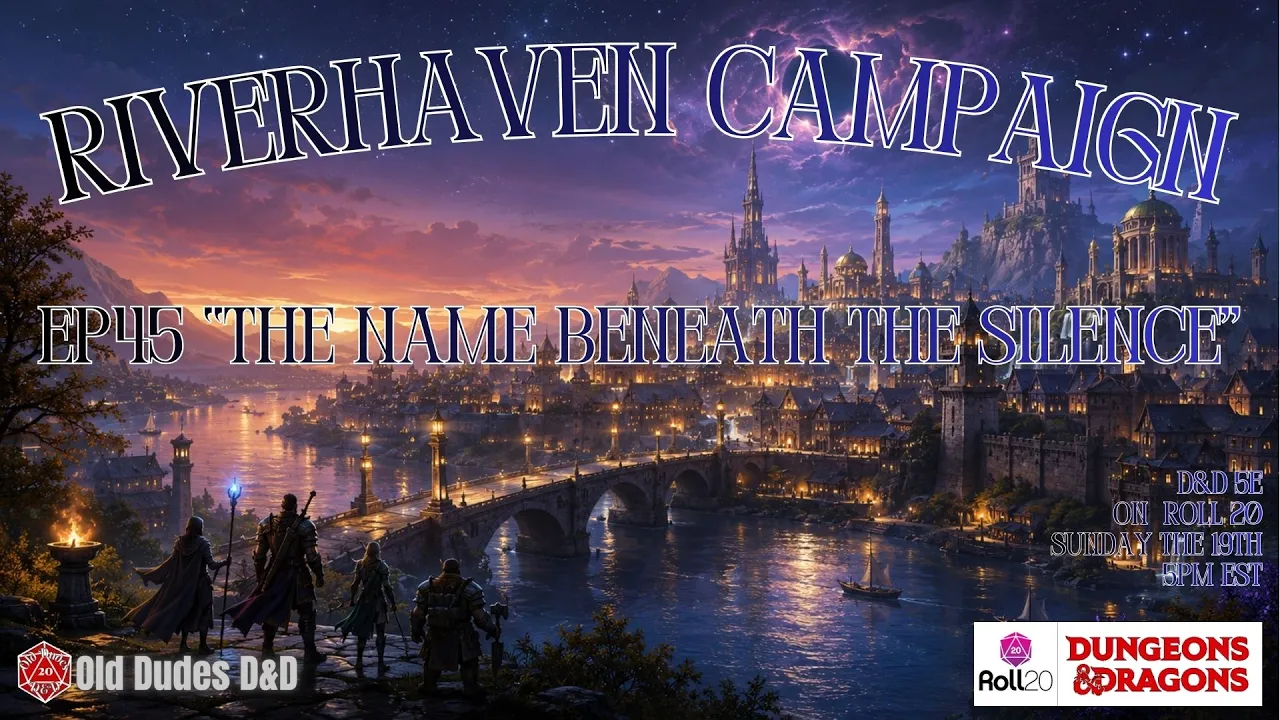
Episode Forty-Five closes inside an undocumented ancient complex, beyond a structure that fell from the sky, with a completed Aegis Crown that cannot explain everything around it.
The party has found evidence of a hidden observatory, planar gates, erased names and an oath to something that should not be spoken.
Now the dead soldiers are waking up.
Whatever comes next is not present in the Riverhaven transcripts supplied in this archive.