WRITTEN RECAP
The Crown of the Aegis Arcanum is whole.
Sspaa has discovered that the crystalline changes he feared were a curse are actually signs of something much stranger.
He is Krysari—a guardian tied to planar boundaries, ley lines and breaches between worlds.
With some of the regular party unavailable, the campaign follows that thread directly.
Serillis has given Sspaa the location of a nearby place where magical lines cross and the boundary between planes is thin. If his new abilities are real, this is where he should begin learning how to use them.
The mission starts as equal parts training exercise and existential job orientation.
Sspaa can sense disturbances he could not previously recognize. Places that once would have felt merely strange now carry direction and pressure, almost like cracks visible to only one person.
The crystalline aspect of his transformation also makes more sense. It is not random corruption. It is part of his connection to the structures separating planes.
The group reaches the disturbance and discovers that the breach is not theoretical.
Extraplanar beings have been using or probing the weak point. The party has to fight while Sspaa attempts to understand what the tear is doing and how his new powers interact with it.
That is difficult because "learn your new supernatural responsibility while monsters attack" is apparently the standard training program for ancient magical orders in Riverhaven.
Sspaa begins manipulating the breach rather than merely attacking whatever comes through it. He can feel how the ley lines meet, where the opening is unstable and what it means to push two planes apart rather than allow them to overlap.
The ability connects back to earlier events across the campaign.
The strange planar gates beneath the Aegis sites.
The Elder Tree invasion.
The impossible golden gate in Umbraxion's prison.
Even earlier moments when Sspaa reacted unexpectedly to magical transitions now look less like isolated quirks.
He has been moving toward this role for some time without knowing its name.
The episode remains very much an Old Dudes session. Every revelation about cosmic duty is balanced by questions about whether there is a wand, whether somebody can get a better weapon and how exactly one is supposed to put "prevent cataclysm" on a character sheet.
By the end of the mission, Sspaa has begun successfully exercising the Krysari ability to recognize and control planar disturbances.
He is not a master.
He has a starting point.
That distinction matters, because Serillis has warned him that more breaches are likely and that there are forces actively interested in making the planes merge.
Riverhaven's problems are no longer contained beneath Riverhaven.
The action has another layer as well. The episode follows Sspaa to a nearby ley-line crossing where Serillis says his Krysari abilities should begin to manifest. The group has to learn the place while moving through it, and that makes every new clue immediately practical. A symbol can become a key. A prisoner can become a witness. A strange relic can be the reason the next door opens—or the reason everybody suddenly needs a saving throw. Riverhaven has trained the party to treat exploration as part of the danger instead of the quiet time between fights.
When the fighting starts, extraplanar creatures appear around the weak point, forcing the party to protect the area while Sspaa interacts with the breach itself. The heroes increasingly work as a real unit rather than five or six separate character sheets. The front line buys room for archers and spellcasters, the scouts try to keep the group from walking blind into the next threat, and healing is saved for the moments when somebody is one bad hit from disappearing. The exact plan changes from room to room, but the basic trust underneath it is becoming one of the party's strongest advantages.
Naturally, none of that prevents the table from wandering into its own kind of trouble. Cosmic responsibility immediately becomes a request for a better wand or sword, because the Old Dudes refuse to let a planar awakening become too dignified. That is the Old Dudes rhythm by now: somebody makes the sensible observation, somebody else makes the joke, and a third person pushes the button while the discussion is still happening. The humor never really stops the adventure. Most of the time it is happening at exactly the same moment the characters are making decisions that could get them killed.
Underneath the jokes, the character stakes keep moving. Sspaa learns that the crystalline traits are part of his new role rather than merely a curse and begins sensing the structure of tears between planes. Riverhaven has become very good at bringing old choices back around. A weapon found months earlier can suddenly matter to a new enemy. An NPC rescued in one arc can become the person who explains the next. A disgrace, curse, vision or bloodline that began as backstory can eventually become the reason the whole party is standing in a particular room.
The larger pattern also gets harder to ignore. The Krysari can close breaches and oppose forces trying to merge planes, which retroactively explains several of Sspaa’s unusual reactions to gates earlier in the campaign. At first the heroes could treat the Gloomstalkers, the Steelwind Dragoons, the Aegis Arcanum, Umbraxion, the infernal prisons and the planar breaches as separate mysteries. With every new site, that becomes less believable. Riverhaven was protected by overlapping systems and orders, and somebody—or several somebodies—has been finding the weak points in all of them.
By the late campaign, the group is carrying an extraordinary amount of history into every encounter. The names on the character sheets are attached to redeemed orders, ancient artifacts, curses survived, dead enemies, planar duties and obligations to Riverhaven itself. That makes even routine tactical choices feel heavier. Retreat might save hit points but abandon a responsibility. Taking a relic may strengthen the party but wake another old system. Killing the obvious enemy may still leave the real prison, gate or oath untouched.
By the time the immediate danger settles, Sspaa returns to the group with the first practical control of his new powers just as Hayben’s Steelwind restoration thread moves to the foreground. The party rarely gets a clean reset after a victory. One answer exposes another door, and one rescued person usually knows the name of the next place nobody wants to visit. That momentum is what carries Riverhaven forward: the heroes keep solving the problem in front of them only to discover that it was connected to something older, larger and usually much less willing to stay buried.
That combination puts a different kind of pressure on the group. Sspaa learns that the crystalline traits are part of his new role rather than merely a curse and begins sensing the structure of tears between planes. The heroes cannot treat the episode as an isolated job because the people and relics involved already have history with them. What would once have been a simple decision about whether to press forward now carries obligations: promises made to Riverhaven, old orders that need restoring, curses that have to be controlled, or ancient defenses that may fail if the wrong piece is disturbed.
Even the quieter stretches remain tense because the Krysari can close breaches and oppose forces trying to merge planes, which retroactively explains several of Sspaa’s unusual reactions to gates earlier in the campaign. The party spends those moments checking what it has learned against what it has already seen, trying to decide whether a familiar symbol means safety or simply a familiar kind of danger. Then Sspaa returns to the group with the first practical control of his new powers just as Hayben’s Steelwind restoration thread moves to the foreground. The result is another Riverhaven transition where the solution to one scene becomes the map to the next problem before anyone has time to decide they are finished for the day.
The city is becoming a place where ancient wards, infernal prisons and planar boundaries intersect.
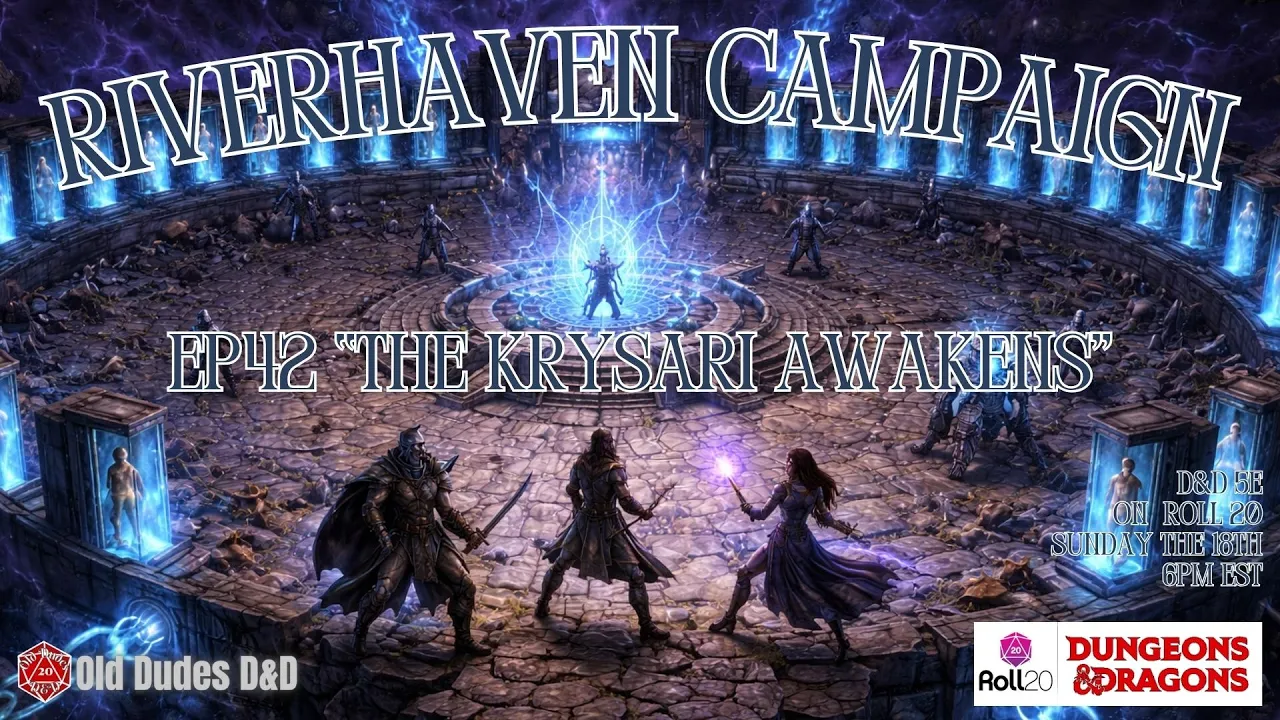
Episode Forty-Two ends with Sspaa returning to the others with a new understanding of himself.
The kenku archer who once specialized in finding angles and copying sounds now has another job.
When reality starts tearing open, he is one of the people expected to close it.