WRITTEN RECAP
The statues in the Binding Ward do exactly what everyone expected.
They wake up.
Ancient spirits emerge from the soldier figures and attack, turning the chamber into another test of the party's ability to fight creatures that do not care very much about ordinary anatomy.
The heroes defeat them and continue through the corrupted lower levels of the vault.
The black influence becomes harder to dismiss as environmental damage. Umbraxion's presence is reaching into the old Aegis defenses, twisting spaces that were originally built to contain powers like him.
The party eventually reaches the relic it came for.
Another piece of the Crown of the Aegis Arcanum.
Recovering it strengthens the artifact's guidance and brings the heroes one step closer to reconstructing the tool that can restore the vault network.
But the crown does not point them home.
It points them deeper.
A route opens toward what appears to be the final or most important Aegis prison associated with Umbraxion himself.
The transition changes the atmosphere immediately.
The heroes enter a place that is not merely storing old weapons or maintaining a local ward. This is a containment site for the ancient shadow power the campaign has been circling since Stonemire Manor.
The first chambers are filled with shades and shadow creatures.
Then Hayben meets a ghost from his own history.
General Thal appears as a corrupted death-knight-like figure.
Thal is tied to the destruction and disgrace of the Steelwind Dragoons, one of the people whose actions helped shape Hayben's entire story. His presence here confirms that the old military betrayal was connected to Umbraxion, not simply to personal ambition or battlefield failure.
For Hayben, the crown quest has suddenly become another stage of his redemption.
Truth Seeker cleared his name.
Now the man behind part of that shame is standing between the party and the prison of a shadow power.
The symbolism would be elegant if Thal were not trying to kill them.
The session moves toward the confrontation with shades surrounding the corrupted general and the final vault stretching beyond him.
The Aegis crown and the infernal imagery of chains begin to overlap in the party's understanding. Riverhaven's ancient defenders used different systems against different threats, but the principle was the same: dangerous powers were bound because destroying them was not always possible.
The action has another layer as well. The soldier spirits animate, the party clears them and recovers another Crown piece before the artifact guides them toward the vault containing Umbraxion’s prison. The group has to learn the place while moving through it, and that makes every new clue immediately practical. A symbol can become a key. A prisoner can become a witness. A strange relic can be the reason the next door opens—or the reason everybody suddenly needs a saving throw. Riverhaven has trained the party to treat exploration as part of the danger instead of the quiet time between fights.
When the fighting starts, the heroes move from fighting incorporeal guardians into shades and shadow defenders, so magic and radiant-style effects become increasingly important. The heroes increasingly work as a real unit rather than five or six separate character sheets. The front line buys room for archers and spellcasters, the scouts try to keep the group from walking blind into the next threat, and healing is saved for the moments when somebody is one bad hit from disappearing. The exact plan changes from room to room, but the basic trust underneath it is becoming one of the party's strongest advantages.
Naturally, none of that prevents the table from wandering into its own kind of trouble. The satisfaction of finding the crown shard lasts only until the group realizes the crown’s reward is directions to an even worse dungeon. That is the Old Dudes rhythm by now: somebody makes the sensible observation, somebody else makes the joke, and a third person pushes the button while the discussion is still happening. The humor never really stops the adventure. Most of the time it is happening at exactly the same moment the characters are making decisions that could get them killed.
Underneath the jokes, the character stakes keep moving. General Thal appears as a death-knight-like enemy, turning Hayben’s old Steelwind betrayal into a direct confrontation inside Umbraxion’s domain. Riverhaven has become very good at bringing old choices back around. A weapon found months earlier can suddenly matter to a new enemy. An NPC rescued in one arc can become the person who explains the next. A disgrace, curse, vision or bloodline that began as backstory can eventually become the reason the whole party is standing in a particular room.
The larger pattern also gets harder to ignore. Thal’s presence confirms that Hayben’s military tragedy was connected to the same ancient shadow power the Aegis were containing. At first the heroes could treat the Gloomstalkers, the Steelwind Dragoons, the Aegis Arcanum, Umbraxion, the infernal prisons and the planar breaches as separate mysteries. With every new site, that becomes less believable. Riverhaven was protected by overlapping systems and orders, and somebody—or several somebodies—has been finding the weak points in all of them.
By the late campaign, the group is carrying an extraordinary amount of history into every encounter. The names on the character sheets are attached to redeemed orders, ancient artifacts, curses survived, dead enemies, planar duties and obligations to Riverhaven itself. That makes even routine tactical choices feel heavier. Retreat might save hit points but abandon a responsibility. Taking a relic may strengthen the party but wake another old system. Killing the obvious enemy may still leave the real prison, gate or oath untouched.
By the time the immediate danger settles, the party reaches the final prison with the crown stronger and one of Hayben’s most important enemies waiting in front of it. The party rarely gets a clean reset after a victory. One answer exposes another door, and one rescued person usually knows the name of the next place nobody wants to visit. That momentum is what carries Riverhaven forward: the heroes keep solving the problem in front of them only to discover that it was connected to something older, larger and usually much less willing to stay buried.
That combination puts a different kind of pressure on the group. General Thal appears as a death-knight-like enemy, turning Hayben’s old Steelwind betrayal into a direct confrontation inside Umbraxion’s domain. The heroes cannot treat the episode as an isolated job because the people and relics involved already have history with them. What would once have been a simple decision about whether to press forward now carries obligations: promises made to Riverhaven, old orders that need restoring, curses that have to be controlled, or ancient defenses that may fail if the wrong piece is disturbed.
Even the quieter stretches remain tense because Thal’s presence confirms that Hayben’s military tragedy was connected to the same ancient shadow power the Aegis were containing. The party spends those moments checking what it has learned against what it has already seen, trying to decide whether a familiar symbol means safety or simply a familiar kind of danger. Then the party reaches the final prison with the crown stronger and one of Hayben’s most important enemies waiting in front of it. The result is another Riverhaven transition where the solution to one scene becomes the map to the next problem before anyone has time to decide they are finished for the day.
The party also has to keep the immediate danger from overwhelming the larger purpose. The heroes move from fighting incorporeal guardians into shades and shadow defenders, so magic and radiant-style effects become increasingly important. At the same time, the satisfaction of finding the crown shard lasts only until the group realizes the crown’s reward is directions to an even worse dungeon. That combination is exactly why apparently straightforward objectives keep becoming memorable: the characters are making life-or-death choices while the players are still friends around a table, teasing one another, checking a rule and then snapping back into the fight when the next roll lands.
Now those bindings are failing together.
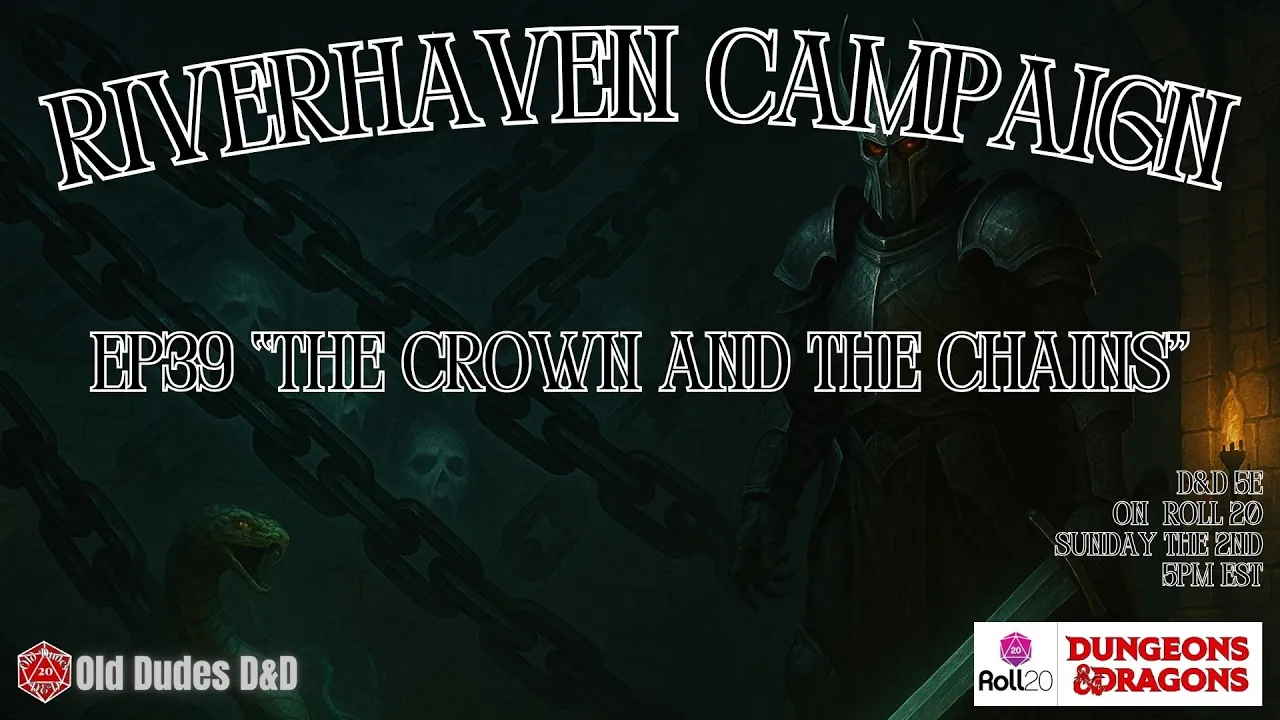
Episode Thirty-Nine ends at the threshold of Umbraxion's prison with the crown stronger, the shadows thicker and General Thal waiting.
Hayben has already faced the dead of his past once.
This time, the past has drawn a weapon.