WRITTEN RECAP
The party returns from Malakai's clockwork refuge with two victories that have been a long time coming.
Malakai Shadowthorn is dead.
Eth is no longer being controlled by the Blade of Eternal Hunger.
The heroes can finally turn their attention back to the Crown of the Aegis Arcanum and Riverhaven's failing defenses.
Riverhaven immediately gives them another crisis.
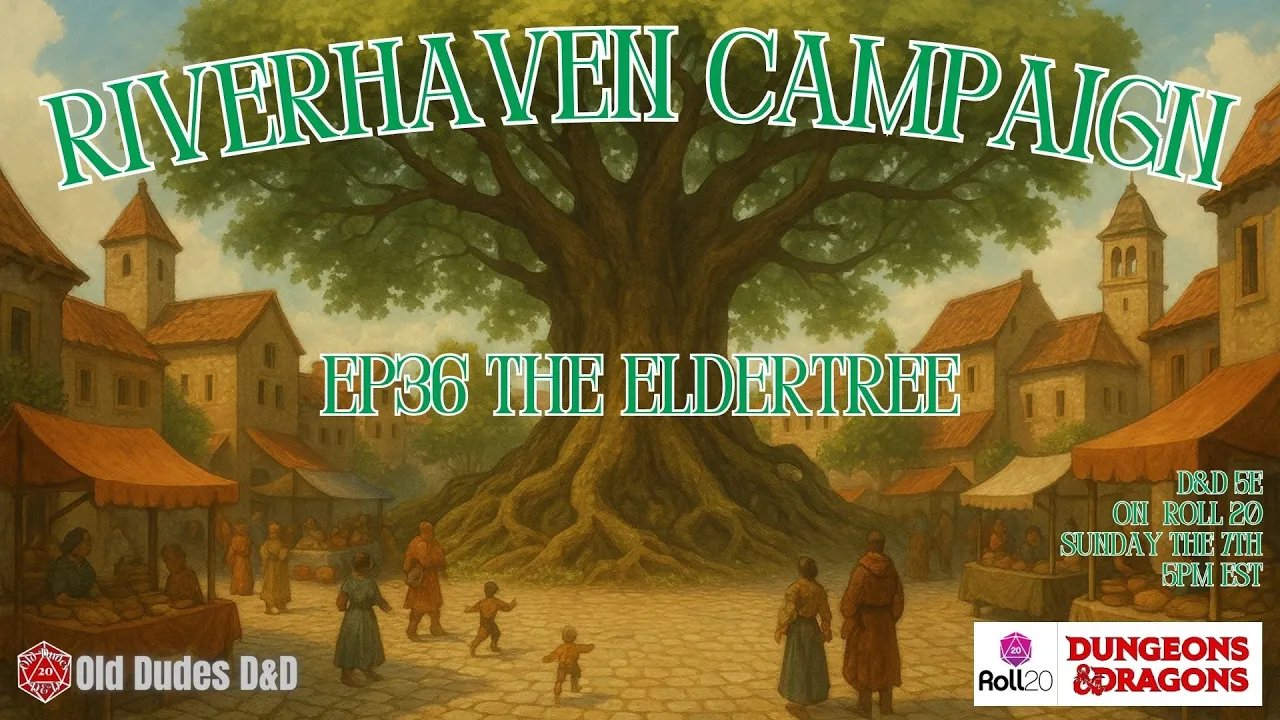
The Elder Tree is changing.
The immense tree has stood as one of the city's defining landmarks, but something unnatural is moving through it. Growth has become hostile. Strange creatures appear among the branches. Magical disturbances suggest an influence that does not belong to the normal world.
The party climbs.
The Elder Tree is essentially a vertical dungeon, which creates a new tactical problem: falling off the map now has a much more literal meaning.
As they ascend, the heroes encounter extraplanar creatures that vanish or dissolve strangely when defeated. Drachen's attacks help confirm that these things do not behave like ordinary beasts from the surrounding region.
Something has pushed through from somewhere else.
Sspaa then discovers what may be the largest possible version of "don't poke the hornet's nest."
He pokes the hornet's nest.
The result is an attack by enormous demonic or planar insects.
The Old Dudes react with the appropriate amount of surprise for people who intentionally disturbed an obviously threatening nest while climbing a magical tree under supernatural assault.
Combat among the branches becomes a mixture of ranged attacks, close-quarters fighting and constant awareness that there is a significant distance between the party and the ground.
The creatures are defeated, but they confirm the larger problem.
The Elder Tree is not simply sick.
It is being invaded.
The party keeps climbing toward the upper bloom, where the disturbance appears strongest. The higher they go, the more the tree feels like a boundary rather than merely a plant—something rooted in Riverhaven but connected to magical forces the city normally does not see.
That has obvious implications for the crown and the vault network.
The Aegis defended Riverhaven against more than one kind of threat. Their wards were tied to planes, prisons and old powers. If those systems are weakening, the Elder Tree may be another place where the barrier between worlds has become thin.
The action has another layer as well. The Elder Tree becomes a vertical dungeon as the party climbs through hostile growth and encounters extraplanar creatures among the branches. The group has to learn the place while moving through it, and that makes every new clue immediately practical. A symbol can become a key. A prisoner can become a witness. A strange relic can be the reason the next door opens—or the reason everybody suddenly needs a saving throw. Riverhaven has trained the party to treat exploration as part of the danger instead of the quiet time between fights.
When the fighting starts, height makes movement and knockback more dangerous while creatures can attack from angles unavailable in a normal stone room. The heroes increasingly work as a real unit rather than five or six separate character sheets. The front line buys room for archers and spellcasters, the scouts try to keep the group from walking blind into the next threat, and healing is saved for the moments when somebody is one bad hit from disappearing. The exact plan changes from room to room, but the basic trust underneath it is becoming one of the party's strongest advantages.
Naturally, none of that prevents the table from wandering into its own kind of trouble. Sspaa literally disturbs a giant planar hornet nest, producing exactly the consequence everybody at the table could see coming. That is the Old Dudes rhythm by now: somebody makes the sensible observation, somebody else makes the joke, and a third person pushes the button while the discussion is still happening. The humor never really stops the adventure. Most of the time it is happening at exactly the same moment the characters are making decisions that could get them killed.
Underneath the jokes, the character stakes keep moving. Drachen notices extraplanar enemies disappearing strangely when killed, while Sspaa’s relationship with planar disturbances begins foreshadowing his later Krysari role. Riverhaven has become very good at bringing old choices back around. A weapon found months earlier can suddenly matter to a new enemy. An NPC rescued in one arc can become the person who explains the next. A disgrace, curse, vision or bloodline that began as backstory can eventually become the reason the whole party is standing in a particular room.
The larger pattern also gets harder to ignore. The invasion suggests weakened Aegis wards are affecting boundaries between worlds, not only physical prisons beneath the city. At first the heroes could treat the Gloomstalkers, the Steelwind Dragoons, the Aegis Arcanum, Umbraxion, the infernal prisons and the planar breaches as separate mysteries. With every new site, that becomes less believable. Riverhaven was protected by overlapping systems and orders, and somebody—or several somebodies—has been finding the weak points in all of them.
By the late campaign, the group is carrying an extraordinary amount of history into every encounter. The names on the character sheets are attached to redeemed orders, ancient artifacts, curses survived, dead enemies, planar duties and obligations to Riverhaven itself. That makes even routine tactical choices feel heavier. Retreat might save hit points but abandon a responsibility. Taking a relic may strengthen the party but wake another old system. Killing the obvious enemy may still leave the real prison, gate or oath untouched.
By the time the immediate danger settles, after the hornet fight, the heroes keep climbing toward a voice at the upper bloom that claims the Elder Tree for itself. The party rarely gets a clean reset after a victory. One answer exposes another door, and one rescued person usually knows the name of the next place nobody wants to visit. That momentum is what carries Riverhaven forward: the heroes keep solving the problem in front of them only to discover that it was connected to something older, larger and usually much less willing to stay buried.
That combination puts a different kind of pressure on the group. Drachen notices extraplanar enemies disappearing strangely when killed, while Sspaa’s relationship with planar disturbances begins foreshadowing his later Krysari role. The heroes cannot treat the episode as an isolated job because the people and relics involved already have history with them. What would once have been a simple decision about whether to press forward now carries obligations: promises made to Riverhaven, old orders that need restoring, curses that have to be controlled, or ancient defenses that may fail if the wrong piece is disturbed.
Even the quieter stretches remain tense because the invasion suggests weakened Aegis wards are affecting boundaries between worlds, not only physical prisons beneath the city. The party spends those moments checking what it has learned against what it has already seen, trying to decide whether a familiar symbol means safety or simply a familiar kind of danger. Then after the hornet fight, the heroes keep climbing toward a voice at the upper bloom that claims the Elder Tree for itself. The result is another Riverhaven transition where the solution to one scene becomes the map to the next problem before anyone has time to decide they are finished for the day.
The party also has to keep the immediate danger from overwhelming the larger purpose. Height makes movement and knockback more dangerous while creatures can attack from angles unavailable in a normal stone room. At the same time, Sspaa literally disturbs a giant planar hornet nest, producing exactly the consequence everybody at the table could see coming. That combination is exactly why apparently straightforward objectives keep becoming memorable: the characters are making life-or-death choices while the players are still friends around a table, teasing one another, checking a rule and then snapping back into the fight when the next roll lands.
By the end of Episode Thirty-Six, the heroes have climbed through hostile growth, fought extraplanar creatures and survived Sspaa's contribution to giant-insect population control.
They are nearing the top of the Elder Tree.
Something above them has claimed the tree as its own.
And whatever it is, it knows the heroes are coming.