WRITTEN RECAP
The warning has run out of time.
Taros is coming free.
The party has fought through chain wardens, infernal chambers and damaged seals. They have recovered enough of the prison's mechanisms to reach the inner confrontation, but every step closer has also weakened the distance between Taros and Riverhaven.
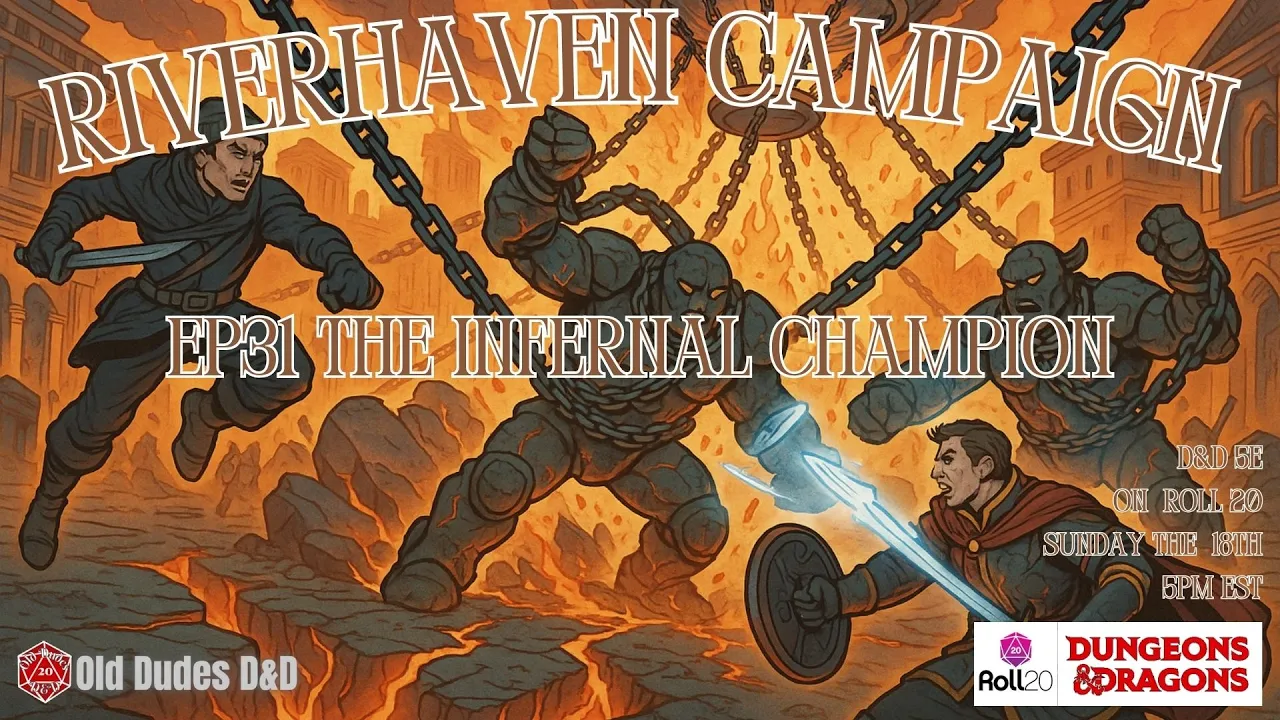
Now the infernal champion stands at the center of a battlefield built from fire, chains and collapsing wards.
The fight is enormous.
Anchors and chains stretch across the area, each one tied to the prison that once held Taros. Some have already broken. Others can be targeted. Infernal creatures and bound servants add pressure while Taros himself hits with the force expected from something earlier defenders chose to imprison rather than destroy.
The Old Dudes quickly realize this is not a normal boss fight.
Attacking Taros alone is not enough.
The chains matter.
The anchors matter.
Keeping each other alive matters more than almost anything.
The group spreads its efforts. Sspaa uses his bow to hit targets across the battlefield. Hayben closes distance and absorbs punishment that would flatten less durable characters. Eth fights with the cursed Blade of Eternal Hunger whispering its own agenda into every decision. Drachen uses magic and defense to hold positions that would otherwise collapse. Umeren burns through healing and death-related magic trying to keep the fight from turning into a funeral.
People go down.
Then they get back up.
Then they go down again.
At points, roughly half the party is on or near death's door.
Sspaa falls hard enough that the aftermath will require the city itself to bring him back. Other characters make death saves while the fight continues around them. The table stops joking for stretches because everyone understands that a few bad rolls could turn the campaign into a very different story.
Even then, the Old Dudes still find time to argue about targeting the correct chain.
Eventually the battlefield begins to turn.
The remaining anchors are broken or neutralized in the right sequence. Taros loses the protections and structure that have allowed him to dominate the fight. The heroes focus everything they have left on the infernal champion.
Taros falls.
Riverhaven survives.
Barely.
The aftermath feels different from earlier victories because the city knows how close the disaster came. Taros had once been connected to Riverhaven as a guardian before being corrupted or turned by an unknown influence. Whatever changed him transformed a protector into the infernal threat that nearly destroyed the place he once defended.
The city celebrates the party publicly.
Banners go up across the square. Crowds gather shoulder to shoulder. The heroes who began as strangers answering a mayor's summons are now the people Riverhaven credits with stopping an infernal catastrophe.
Sspaa is restored to life in a grateful civic effort, though the exact details remain suitably mysterious. His horse also emerges from the rubble alive, apparently having decided that explanations are optional.
The party receives rewards suited to their growing legend.
Hayben is given the Belt of Relentless Might, granting bursts of extraordinary strength without requiring him to purchase every strength potion in the city.
Sspaa receives the Bow of the Echoing Arc.
Drachen receives Spell Vector Grips, blending his martial attacks more effectively with arcane power.
Other rewards include a crystal focus worn on a chain and additional relics recovered during the battle.
There is also the matter of Taros's weapons.
Powerful swords have a habit of surviving their owners in this campaign, and the party's collection of dangerous talking or cursed blades is becoming less of an inventory category and more of a social problem.
Most importantly, the Crown of the Aegis Arcanum remains unfinished.
The first piece provides visions or guidance toward the remaining vaults. Taros may be defeated, but the vault network is still compromised and Umbraxion remains the larger shadow behind the campaign.
Episode Thirty-One ends with Riverhaven celebrating.
The heroes are alive.
Mostly.
The action has another layer as well. The Taros battle takes place across anchors and chains while the infernal champion and his servants turn the collapsing prison into a multi-objective battlefield. The group has to learn the place while moving through it, and that makes every new clue immediately practical. A symbol can become a key. A prisoner can become a witness. A strange relic can be the reason the next door opens—or the reason everybody suddenly needs a saving throw. Riverhaven has trained the party to treat exploration as part of the danger instead of the quiet time between fights.
When the fighting starts, several heroes are reduced to death saves or near death, and Sspaa falls hard enough to require restoration by Riverhaven afterward. The heroes increasingly work as a real unit rather than five or six separate character sheets. The front line buys room for archers and spellcasters, the scouts try to keep the group from walking blind into the next threat, and healing is saved for the moments when somebody is one bad hit from disappearing. The exact plan changes from room to room, but the basic trust underneath it is becoming one of the party's strongest advantages.
Naturally, none of that prevents the table from wandering into its own kind of trouble. Even during a lethal boss fight, the group has to stop and verify which chain is a target and which effect belongs to whom, classic high-level Foundry chaos. That is the Old Dudes rhythm by now: somebody makes the sensible observation, somebody else makes the joke, and a third person pushes the button while the discussion is still happening. The humor never really stops the adventure. Most of the time it is happening at exactly the same moment the characters are making decisions that could get them killed.
Underneath the jokes, the character stakes keep moving. Hayben, Sspaa and Drachen each receive civic rewards afterward, while Eth’s cursed blade survives the victory with its own agenda intact. Riverhaven has become very good at bringing old choices back around. A weapon found months earlier can suddenly matter to a new enemy. An NPC rescued in one arc can become the person who explains the next. A disgrace, curse, vision or bloodline that began as backstory can eventually become the reason the whole party is standing in a particular room.
The larger pattern also gets harder to ignore. Taros is remembered as a former guardian of the city who was somehow turned, adding another example of old protectors being corrupted instead of simply defeated. At first the heroes could treat the Gloomstalkers, the Steelwind Dragoons, the Aegis Arcanum, Umbraxion, the infernal prisons and the planar breaches as separate mysteries. With every new site, that becomes less believable. Riverhaven was protected by overlapping systems and orders, and somebody—or several somebodies—has been finding the weak points in all of them.
By this stage of the campaign, the heroes have enough history that resource choices carry consequences. A spell slot used on the first guardian may not be there for the boss. A potion forgotten in a backpack can suddenly matter. A cursed weapon may solve today's fight while creating next week's problem. The players spend plenty of time checking ranges, conditions, concentration and inventory, but those rule questions are attached to real stakes now because the group has people, places and unfinished promises it is trying to get back to alive.
By the time the immediate danger settles, Riverhaven celebrates, restores Sspaa, and the incomplete Crown immediately points the heroes toward the next Aegis vault. The party rarely gets a clean reset after a victory. One answer exposes another door, and one rescued person usually knows the name of the next place nobody wants to visit. That momentum is what carries Riverhaven forward: the heroes keep solving the problem in front of them only to discover that it was connected to something older, larger and usually much less willing to stay buried.
The infernal champion is dead.
And for perhaps the first time in many sessions, everyone has a chance to look around and realize how far the campaign has moved from missing pilgrims at a healing spring.
They saved the city.
Now they have to save the system that keeps the things beneath it from getting out.