WRITTEN RECAP
Riverhaven has survived the attack, but victory aboveground has exposed the real problem below it.
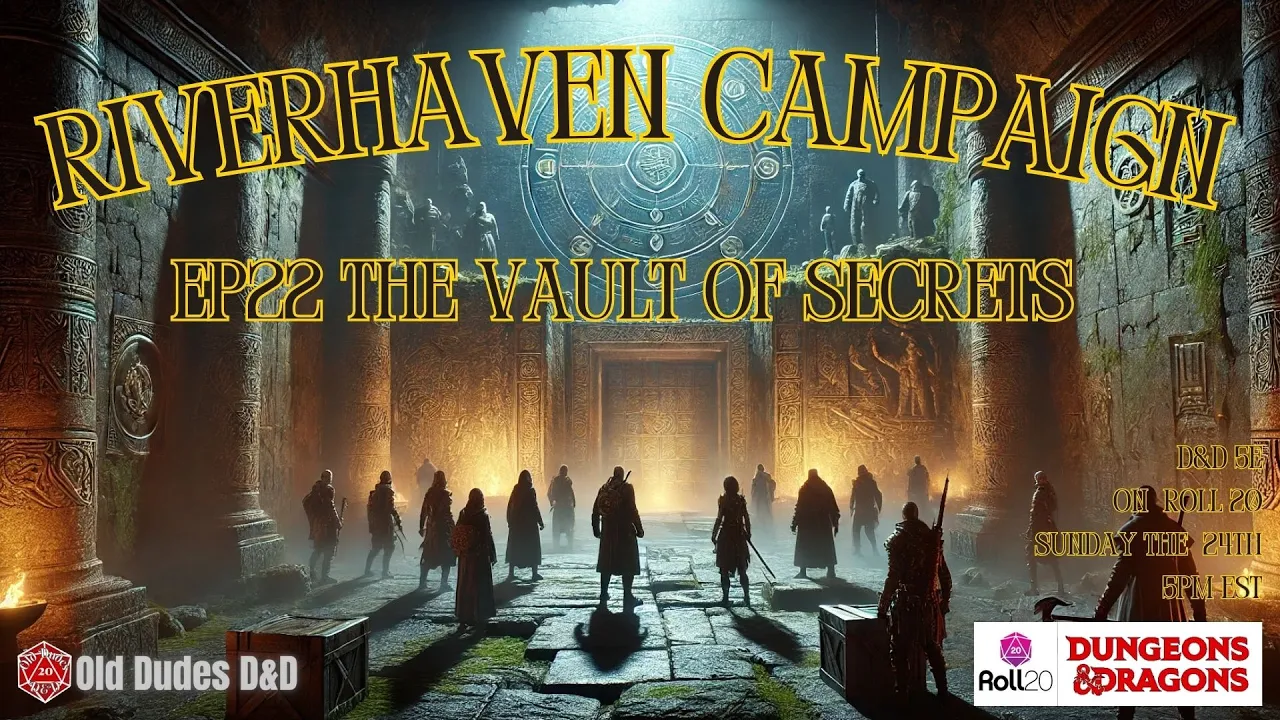
The coordinated assault by Hakar's followers and the Gloomstalkers was a diversion. While guards, militia and the party were busy keeping the city from collapsing into chaos, someone opened a route into a buried complex beneath the Elder Tree plaza. The markings around the entrance point directly toward the Aegis Arcanum, the ancient shield-wizard order Drachen has been uncovering piece by piece.
So after resting, resupplying and doing the usual Old Dudes inventory ritual—where everyone discovers that somebody has a potion they forgot about—the party descends.
The staircase seems to go down forever. Aegis runes glow faintly along old stone, and the deeper they travel, the more obvious it becomes that this was not merely a basement or storage room. It was a protected installation designed by people who expected their secrets to survive long after they did.
The first chambers are filled with damaged shields, tarnished equipment and the remains of defensive stations. Some objects are useless. Others still hold magic. One shield carries a burst of brilliant light, the sort of relic that might once have belonged to an Aegis defender. Drachen studies everything he can, because every shield emblem feels increasingly like somebody has been leaving him a personal scavenger hunt for several hundred years.
Then the party encounters a sword set into an old pedestal.
Naturally, everyone immediately debates who should pull it.
There is a short period in which the group pretends this is a careful archaeological decision. Then Drachen removes the weapon, because at some point the only way to learn whether the ancient sword is a key, a spell, a trap or a terrible life decision is to pull it out and see what happens.
That philosophy continues to serve the Old Dudes about as well as it always has.
The vault's guardians begin appearing as the party presses east. Ancient undead and constructed defenders still recognize intruders even if the organization that created them is long gone. The group fights through them, using the increasingly familiar combination of front-line pressure, ranged attacks and magic to keep enemies from surrounding the more fragile members.
What makes this place different from earlier ruins is the sense that the defenses were built for a purpose that may still matter. The Aegis did not simply hide treasure. They were preserving knowledge, weapons and mechanisms connected to something they expected might threaten Riverhaven again.
The strangest discovery comes in a chamber lined with grotesque magical cages.
Some of the things in them are dead. Some are undead. Some appear to have been imprisoned so long that nobody at the table is entirely sure whether releasing them would be mercy, stupidity or both.
The party fights creatures that emerge from the cages and, once the room is under control, Umeren makes use of the fact that being dead does not necessarily mean being unavailable for questioning.
Talking to dead things is becoming one of Riverhaven's more reliable investigative techniques.
The answers are fragmented, but one detail survives: there is a machine deeper in the vault.
That immediately becomes the next objective.
The group searches the chambers, follows old routes and checks doors that are suspicious mostly because every door in an Aegis vault is suspicious by definition. Sspaa investigates. Eth watches for opportunities. Hayben and the other armored members stand close enough to absorb the consequences if the rogues are wrong. Drachen tries to read the site as both dungeon and family history.
The table, meanwhile, manages to turn one ancient door into a debate over automobiles, proving that even centuries-old arcane architecture cannot protect a D&D session from Dodge Monaco jokes.
Eventually the party passes beyond the cages and into a section where the architecture becomes more technical. Old Aegis symbols surround passages that feel less like tombs and more like access corridors. Whatever lies ahead was not meant to be admired. It was meant to function.
The party reaches the next chamber and begins to understand why the dead prisoners spoke about a machine.
Something enormous is waiting deeper in the complex.
They have not yet seen all of it, but the traces are unmistakable: arcane power, mechanical structure and crystal components far beyond anything in the abandoned rooms behind them.
The city attack now makes more sense.
Someone did not open this vault simply to steal an old shield.
They wanted access to Aegis technology.
The action has another layer as well. The newly exposed Aegis complex contains broken shields, old runes, a sword set into a pedestal and grotesque magical cages holding dead or undead prisoners. The group has to learn the place while moving through it, and that makes every new clue immediately practical. A symbol can become a key. A prisoner can become a witness. A strange relic can be the reason the next door opens—or the reason everybody suddenly needs a saving throw. Riverhaven has trained the party to treat exploration as part of the danger instead of the quiet time between fights.
When the fighting starts, guardians repeatedly emerge while the party tries to inspect the vault, so investigation and combat overlap rather than happening in separate rooms. The heroes increasingly work as a real unit rather than five or six separate character sheets. The front line buys room for archers and spellcasters, the scouts try to keep the group from walking blind into the next threat, and healing is saved for the moments when somebody is one bad hit from disappearing. The exact plan changes from room to room, but the basic trust underneath it is becoming one of the party's strongest advantages.
Naturally, none of that prevents the table from wandering into its own kind of trouble. The sword-in-the-stone moment and the group’s instinct to have the tougher characters open suspicious doors keep the session grounded in actual table behavior. That is the Old Dudes rhythm by now: somebody makes the sensible observation, somebody else makes the joke, and a third person pushes the button while the discussion is still happening. The humor never really stops the adventure. Most of the time it is happening at exactly the same moment the characters are making decisions that could get them killed.
Underneath the jokes, the character stakes keep moving. Drachen is now walking through the infrastructure of the order that mirrors his own fighter-wizard path, making every Aegis relic more personally important. Riverhaven has become very good at bringing old choices back around. A weapon found months earlier can suddenly matter to a new enemy. An NPC rescued in one arc can become the person who explains the next. A disgrace, curse, vision or bloodline that began as backstory can eventually become the reason the whole party is standing in a particular room.
The larger pattern also gets harder to ignore. Questioning dead prisoners reveals that a machine deeper in the vault is central to whatever the original defenders were doing. At first the heroes could treat the Gloomstalkers, the Steelwind Dragoons, the Aegis Arcanum, Umbraxion, the infernal prisons and the planar breaches as separate mysteries. With every new site, that becomes less believable. Riverhaven was protected by overlapping systems and orders, and somebody—or several somebodies—has been finding the weak points in all of them.
By this stage of the campaign, the heroes have enough history that resource choices carry consequences. A spell slot used on the first guardian may not be there for the boss. A potion forgotten in a backpack can suddenly matter. A cursed weapon may solve today's fight while creating next week's problem. The players spend plenty of time checking ranges, conditions, concentration and inventory, but those rule questions are attached to real stakes now because the group has people, places and unfinished promises it is trying to get back to alive.
By the end of Episode Twenty-Two, Riverhaven's heroes have fought through the outer defenses of the newly opened vault, recovered more pieces of Aegis history, interrogated the dead, survived monsters emerging from ancient cages and identified the next target inside the complex: a machine the old defenders considered important enough to bury beneath the city.
For Drachen, the Aegis Arcanum is no longer a forgotten order described in books.
He is walking through its infrastructure.
And somewhere ahead, the machinery is still alive.