WRITTEN RECAP
The Old Dudes are officially beyond the portal in the Den of the Ancients, which means the sensible option of turning around is still technically available and will not be discussed again.
They carry the pendant taken from the gate guardian, a key that activates the ancient portals. They also carry a new name—Grasha the Unyielding—and very little understanding of what lies in this separated section of the buried complex.
The first major discovery is a hidden chamber containing a giant-sized coffin and the remains of a long-dead warrior. The room is steeped in old magic. A blade associated with the corpse is not simply lying there waiting to be looted; something is bound to it.
Naturally, the party starts touching things.
A trapped presence stirs. The old warrior's spirit and the weapon are tied together by magic that has lasted far longer than anyone expected. What begins as investigation becomes a dangerous confrontation when the force bound to the tomb struggles to escape. The group has to decide whether they are freeing a victim, releasing a monster, or doing both at the same time.
The answer is complicated.
They fight through the chamber's defenses and eventually break the immediate threat. The blade is revealed as an old weapon associated with light and shadow, another relic from the civilization beneath Riverhaven. Like so many things in the Den, it comes with enough history to be interesting and enough unanswered questions to be dangerous.
After a rest, the party continues.
The next major chamber is even less subtle.
Statues stand throughout the room, and a Medusa-like creature waits among them.
Everyone immediately understands what statues in a Medusa room usually mean.
That does not make the fight easier.
The creature's gaze turns the battlefield itself into a tactical problem. Characters avoid looking directly at her, attack through reflections and angles, and try not to become permanent decorations in a dungeon already full of people who made similar mistakes. The animated or enchanted statues add another layer to the fight, forcing the group to split attention between the monster that can petrify them and the things trying to kill them normally.
At one point a creature is turned to stone and drops, proving that the danger is not theoretical.
The Old Dudes respond with their usual blend of genuine tactics and table panic. Spiritual weapons appear, ranged attacks fly, echoes and summoned allies absorb punishment, and there is repeated discussion about who is or is not actually looking at the Medusa.
Eventually she falls.
The party survives with everyone still mostly made of flesh.
They continue deeper and find yet another occupied area, this time a group of orcs surrounding an elven woman who has been restrained and interrogated.
The party intervenes.
The battle is already underway when the next session begins, but the important decision is made here: whoever the woman is, the Old Dudes are not leaving her to the orcs.
There is a brief moment of confusion over whether the woman in the center is someone they are supposed to rescue or kill.
This is clarified before anyone makes the campaign substantially shorter.
Passing through the portal means accepting that the easiest way home is now behind them. The new section hides secret doors, burial chambers and the kind of giant coffin that no experienced adventurer should approach casually. The party approaches it casually.
Within the tomb they encounter an ancient spirit or entity tied to a powerful sword and the history of the complex. The scene adds another layer to the Den: heroes, wardens and prisoners have all left pieces of themselves here. Not every dangerous presence is serving the same master, and not every relic should be understood only by its damage dice.
The next major obstacle is a Medusa-like creature surrounded by statues that suddenly look much less decorative once everyone remembers how petrification works. Avoiding a permanent career as dungeon furniture becomes a priority. The party survives and pushes farther until it discovers orcs guarding an elven woman being held deeper in the ruins.
The rescue attempt becomes another running battle and the episode ends before the party has completely secured the area. It is a classic Riverhaven stopping point: one mystery partly answered, another prisoner found, and enough enemies still standing to make next week's opening initiative roll unavoidable.
The fight becomes brutal enough that several characters are badly hurt. The orcs include dangerous warriors capable of dropping party members, and the captive is still in the middle of the battlefield. The encounter carries into the next episode, leaving the group committed to saving someone whose identity they do not yet know.
The action has another layer as well. Beyond the portal, the party finds secret doors, a massive coffin or tomb, an ancient spirit tied to a sword and a Medusa-like creature surrounded by statues. The group has to learn the place while moving through it, and that makes every new clue immediately practical. A symbol can become a key. A prisoner can become a witness. A strange relic can be the reason the next door opens—or the reason everybody suddenly needs a saving throw. Riverhaven has trained the party to treat exploration as part of the danger instead of the quiet time between fights.
When the fighting starts, petrification changes the way everyone approaches the encounter because a bad result can remove a character without ordinary hit-point damage. The heroes increasingly work as a real unit rather than five or six separate character sheets. The front line buys room for archers and spellcasters, the scouts try to keep the group from walking blind into the next threat, and healing is saved for the moments when somebody is one bad hit from disappearing. The exact plan changes from room to room, but the basic trust underneath it is becoming one of the party's strongest advantages.
Naturally, none of that prevents the table from wandering into its own kind of trouble. The giant coffin receives exactly the amount of suspicion one would expect, followed by exactly the amount of interaction one would expect from this group. That is the Old Dudes rhythm by now: somebody makes the sensible observation, somebody else makes the joke, and a third person pushes the button while the discussion is still happening. The humor never really stops the adventure. Most of the time it is happening at exactly the same moment the characters are making decisions that could get them killed.
Underneath the jokes, the character stakes keep moving. The ancient spirit and relics give Drachen and Hayben more evidence that the Den preserved individual defenders as well as institutional records. Riverhaven has become very good at bringing old choices back around. A weapon found months earlier can suddenly matter to a new enemy. An NPC rescued in one arc can become the person who explains the next. A disgrace, curse, vision or bloodline that began as backstory can eventually become the reason the whole party is standing in a particular room.
The larger pattern also gets harder to ignore. Deeper corridors reveal orcs guarding a captive elf, showing that current factions are occupying spaces built by much older powers. At first the heroes could treat the Gloomstalkers, the Steelwind Dragoons, the Aegis Arcanum, Umbraxion, the infernal prisons and the planar breaches as separate mysteries. With every new site, that becomes less believable. Riverhaven was protected by overlapping systems and orders, and somebody—or several somebodies—has been finding the weak points in all of them.
By this stage of the campaign, the heroes have enough history that resource choices carry consequences. A spell slot used on the first guardian may not be there for the boss. A potion forgotten in a backpack can suddenly matter. A cursed weapon may solve today's fight while creating next week's problem. The players spend plenty of time checking ranges, conditions, concentration and inventory, but those rule questions are attached to real stakes now because the group has people, places and unfinished promises it is trying to get back to alive.
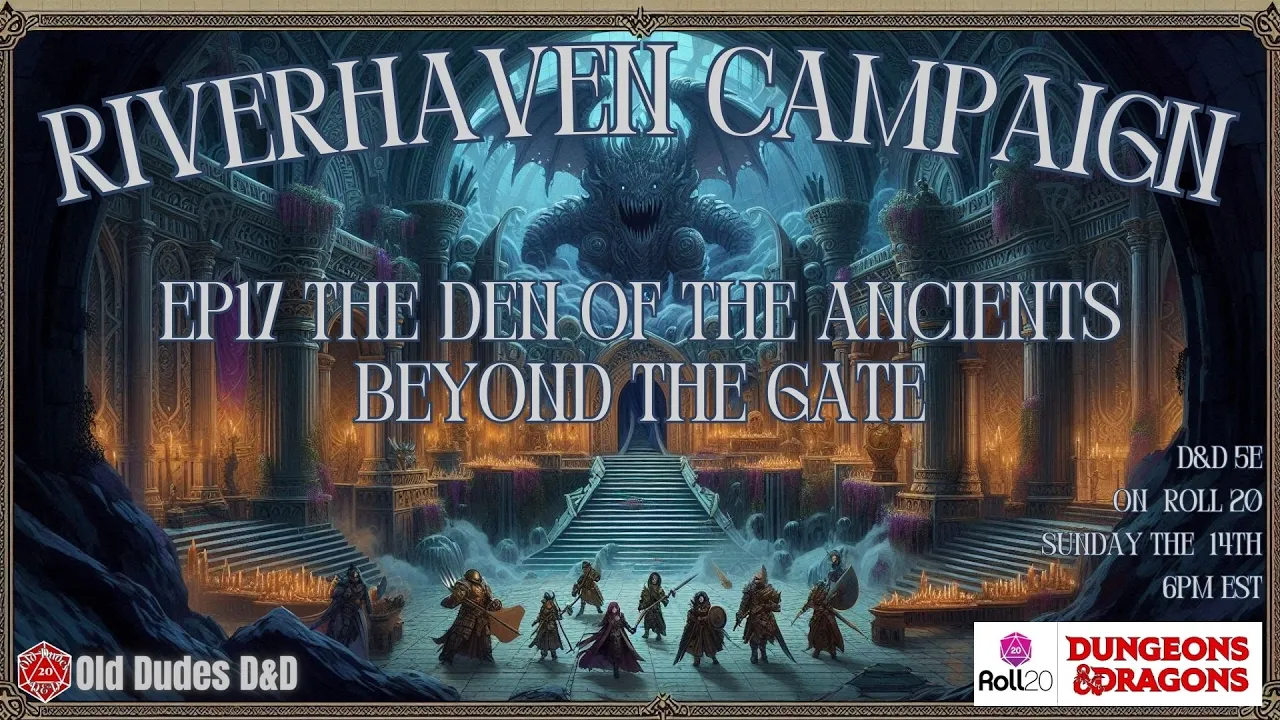
Episode Seventeen therefore pushes the Den from ancient ruin into something much larger. There are functioning portals, imprisoned spirits, old magical weapons, monsters preserved within the complex, and living people moving through it now.
The portal was not simply a door to another room.
It was a road.
And the Old Dudes have started following it.